
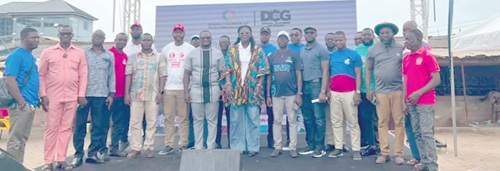
Ghana Chamber of Telecommunications and Digital Chamber of Ghana has called for stronger digital education among consumers as fraudsters increasingly use social engineering to target users of mobile money and other electronic financial services.
The Chief Executive Officer (CEO) of the Chamber, Sylvia Owusu-Ankomah, said the growing use of digital financial services has made continuous public education necessary to help consumers protect their mobile money wallets, SIM cards and personal information.
Speaking during the Mankessim Market Storm, a community engagement and public education programme organised by the Chamber, Ms Owusu-Ankomah said the initiative was unique because it brought different players in the telecommunications industry together to engage consumers directly.
The programme brought together network operators, mobile money and fintech companies, infrastructure providers and fibre companies to educate the public on the safe use of telecommunications and digital services.
She said the Chamber has, over the years, been concerned about customer awareness of digital safety and has introduced community engagements to provide a platform for telecommunications operators and other industry players to interact directly with consumers.
“We use these platforms essentially to drive some sort of digital literacy amongst consumers generally,” she said.
Ms Owusu-Ankomah said the Chamber has observed an increase in social engineering in the mobile and electronic money space.
She explained that although telecommunications companies have invested significantly in resilient platforms and technical security measures, cyber-security threats continued to evolve globally, requiring constant vigilance and public awareness.
She said security agencies should also remain part of the efforts to combat digital fraud because crime committed through digital platforms was still a crime.
According to her, there was the need to equip and upskill security agencies further and improve their responsiveness to complaints involving digital financial services.
Ms Owusu-Ankomah said the Chamber has also engaged the National Communications Authority (NCA) and other relevant institutions on issues affecting consumers.
She said another concern addressed during the engagement was public misconceptions about telecommunications infrastructure, particularly mobile phone towers.
She explained that before a tower was mounted, the necessary permits had to be secured and the infrastructure had to comply with the requirements of the NCA, the Radiation Protection Institute (RPI) and the Environmental Protection Agency (EPA).
She said the RPI was present at the programme to provide consumers with information on the safety of telecommunications towers, rather than leaving operators alone to give such assurances.
Ms Owusu-Ankomah said misconceptions and community resistance to towers could affect the rollout of infrastructure and, consequently, network quality.
She said the only sustainable way to improve network quality was to continue rolling out infrastructure across the country without unnecessary hindrances.
At the Mankessim Divisional Police Command, the Divisional Crime Officer, ASP Hayford Alavi, advised the public to treat mobile money PINs and passwords as strictly personal information.
He said users should never disclose their PINs to other people, regardless of the circumstances.
ASP Alavi disclosed that the command has recorded three mobile money fraud cases this year involving GH¢12,000, GH¢45,000 and GH¢9,000.
He said the total amount involved was GH¢66,000, with suspects in the GH¢12,000 and GH¢9,000 cases arrested, while those connected to the GH¢45,000 case were still being pursued.
He said victims included mobile money vendors, businessmen, mobile phone dealers and individuals whose funds were allegedly withdrawn after they had engaged in conversations with fraudsters.
The Municipal Director of the EPA, Leonard Emmanuel Mensah, said public education was critical in addressing misconceptions about telecommunications infrastructure.
He said, at the municipal level, he has not received complaints about monitored telecommunications towers, although such complaints could be received at the regional level.
Mr Mensah said some of the common misconceptions related to claims that telecommunications towers could cause health problems, including cancer, or attract lightning.
He said the EPA was prepared to work with the Ghana Chamber of Telecommunications to educate communities before infrastructure projects were undertaken.
For some participants, the engagement offered practical lessons on how to avoid becoming victims of mobile money fraud.
Hajia Yasmine said she has previously lost GH¢1,800 through mobile money fraud but has become more aware of the need to keep her PIN confidential after participating in the programme.
She said the education had helped her understand that mobile money fraud was a real threat and that users needed to be more cautious.
Another participant, Salmatu Yakubu, said she nearly fell victim to a mobile money fraud attempt but was alerted by a neighbour.
Ms Yakubu expressed concern that former employees could potentially use knowledge acquired from their work to facilitate fraud and urged companies to strengthen security measures around their personnel and former employees.
