
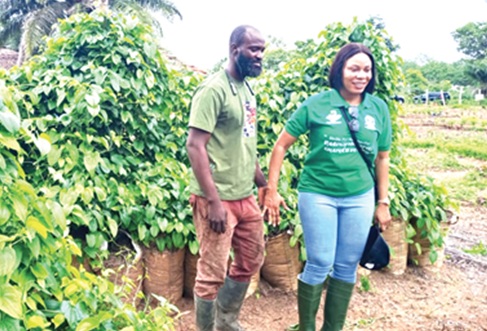
From cultivating yams in sacks and turning discarded vehicle tyres into furniture to serving farm produce in a restaurant, an art teacher in Dambai is demonstrating how creativity can unlock new possibilities in agriculture.
At Oti Farms, a 3.25-acre agritourism facility in Dambai in the Oti Region, 42-year-old Taase Abednego Awuriki combines crop and livestock production with recycling, hospitality and environmental education in an effort to make agriculture more attractive, particularly to young people.
A professional Visual Art teacher at Yabram Community Day Senior High School, Mr Awuriki established the facility in 2018, drawing inspiration from his childhood experiences in farming and his tertiary education in Art Education.
His artistic training has shaped the way he organises the farm, from the innovative use of space for sack farming to transforming discarded materials into useful household items.
A visit to Oti Farms by the Daily Graphic revealed a facility that brings together agriculture, recreation, education and tourism, with the broader objective of creating employment opportunities and promoting environmental conservation.
Sustainable farming
Having grown up in a farming family, Mr Awuriki was familiar with agricultural activities long before he became a teacher. His training in Visual Art education, however, gave him a different perspective on how farming could be organised and made more productive.
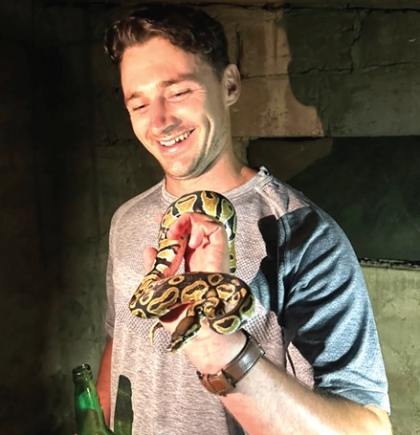
A tourist holding a snake during a visit to Oti Farms
At Oti Farms, this is reflected in a sack-farming system in which yams, cassava, ginger, tomatoes, okro and other vegetables are cultivated in durable sacks filled with compost produced from organic waste.
The method enables crops to be cultivated in relatively small spaces without extensive land preparation. Instead of clearing large areas of land, burning vegetation and constructing mounds, the farm uses sacks to organise production and maximise available space.
The composting process also turns organic waste into a valuable resource. Abednego believes the approach could encourage households and young people without access to large parcels of land to venture into small-scale farming.
Some of the harvested produce is subsequently used in the farm's restaurant, creating a link between agricultural production and hospitality. Visitors can observe crops growing and later enjoy meals prepared with produce from the farm.
He believes the experience provides an opportunity to make agriculture more appealing to people who might otherwise have little interest in farming.
Discarded materials
The creative approach extends beyond crop production. In various sections of the facility, discarded vehicle and motorcycle tyres have been transformed into chairs and other functional furniture.
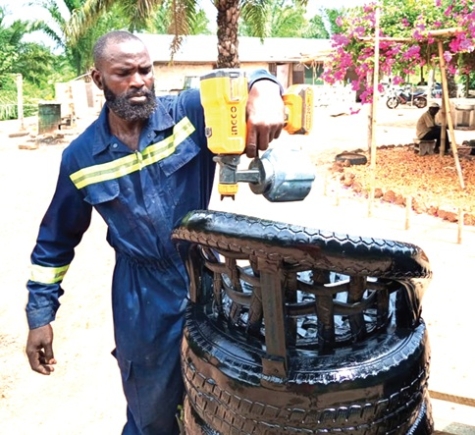
Taase Abednego Awuriki transforms discarded car tyres into functional furniture at his farm, turning waste into art.
The pieces serve practical purposes while demonstrating how materials that would otherwise constitute waste can be recycled and given a new lease of life.
The farm also incorporates plants into its landscaping and livestock management activities.
Cassava and moringa, for instance, serve different purposes, including landscaping and providing leaves for animal feed.
Another feature is the use of susumasa (Newbouldia laevis) as a fencing material.
The plants provide natural boundaries around sections of the facility, particularly areas designated for livestock production.
Reinforced with chain-link protection, the fencing forms part of the farm's commercial goat-rearing enterprise.
The leaves could also be harvested as supplementary animal feed.
For Mr Awuriki, the practices demonstrated how familiar plants and discarded materials could serve multiple purposes while helping farmers make efficient use of available resources.
Agric and tourism
Mr Awuriki is developing Oti Farms as a destination where agriculture, recreation, environmental education and tourism can complement one another.
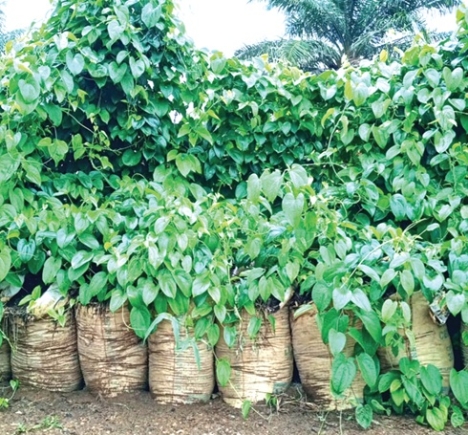
Taase Abednego Awuriki organic yam Farms
The facility has a mini-restaurant, an event ground and park, livestock enclosures and spaces where visitors could observe different agricultural activities.
It rears local chickens, goats, rabbits and grasscutters, alongside a small pet zoo featuring indigenous animals, including snakes.
The attractions provide opportunities for visitors, particularly schoolchildren, to learn about animal husbandry, livestock production and local biodiversity through practical observation. He indicated that the facility attracts an average of 200 visitors daily.
He believes the facility has the potential to become an ecotourism destination in the Oti Region, provided it receives the necessary investment, infrastructure and institutional support.
He hopes that practical exposure to crop production, livestock management and recycling will help change the perception that agriculture is solely about physical labour and present it as a sector offering opportunities for innovation, entrepreneurship and employment.
His expansion plans include accommodation facilities, natural swimming pool features and spaces for agricultural workshops, environmental education and practical training.
Opportunities
Oti Farms currently employs about 15 people, comprising five males and 10 females.
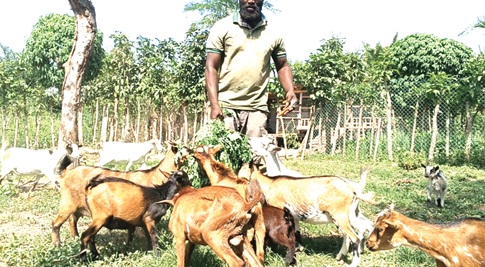
Taase Abednego Awuriki, CEO of Oti Farms, feeding the goats with moringa leaves on his farm
The women are mainly involved in restaurant operations and related activities, while other employees undertake farming, harvesting, cleaning, maintenance and general operations.
Mr Awuriki wants to create more employment opportunities for young people struggling to find jobs after completing their education and demonstrate that they can establish viable businesses within their communities.
He said plans were underway to establish a training hub to equip young people with practical skills in smart farming, recycling and entrepreneurship, as well as the knowledge needed to set up their own ventures.
He said developing Oti Farms into the agritourism destination would require additional investment and infrastructure, and added that the facility hosted the Deputy Chief Executive Officer of the National Innovation and Entrepreneurship Programme (NIEP), Joan Selasie Ahiawordor, in 2025 and was subsequently enlisted under the programme and received some financial support.
Mr Awuriki believes further assistance through government interventions, grants and strategic partnerships could help expand operations, improve facilities and create additional employment opportunities.
He is appealing to investors, development partners and institutions interested in sustainable agriculture, environmental conservation, entrepreneurship and tourism to support the initiative.
He said plans were also underway to use an adjoining parcel of land for expansion, including the provision of accommodation and additional recreational facilities to complement the existing agricultural, hospitality and educational activities.
At its core, Oti Farms reflects Mr Awuriki’s vision of making agriculture more innovative and sustainable by combining creativity with practical enterprise.
He believes the initiative can inspire young people and other aspiring entrepreneurs to identify opportunities in locally available resources, embrace innovation and transform creative ideas into productive ventures.
