
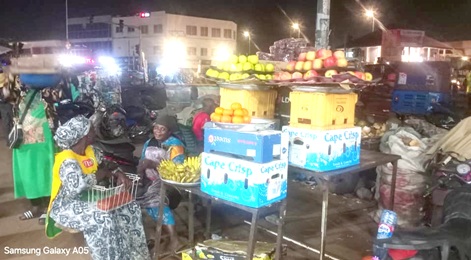
While many traders in the Tamale Metropolis retreat to their homes as darkness falls, another side of the city comes alive, with traders setting up stalls, food vendors preparing for customers and shoppers taking to the streets.
The streets grow busier, traders spread their wares under streetlights, food vendors prepare for late-night customers, and shoppers pour onto the Central Business District (CBD) for trading.
At the Aboabo main lorry station, the taxi rank and beneath the flyover, traders scramble to catch the attention of passers-by. Some of the items being sold are clothes, sandals, mobile phone accessories and foodstuffs.
A stroll through the streets of Tamale at about 11 p.m. last Wednesday revealed traders attending to customers at the Aboabo main lorry station, the taxi rank and beneath the flyover.
When the Daily Graphic visited the area, business was in full swing.
Some traders used torchlights to illuminate goods displayed because of inadequate street lighting, while others relied on the illumination from the available streetlights.
Traders' experiences
For mobile phone accessories dealer, Akiru Abdul Hakim Mohammed, night trading had become an important part of his business, particularly on days when sales were poor.
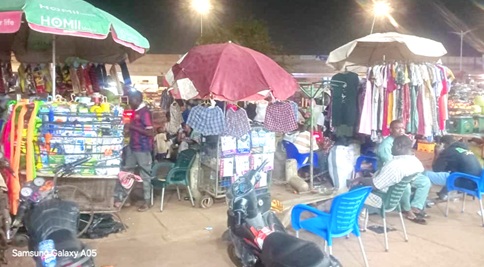
Traders are already cashing in on the business boom
He said he had been engaged in night trading for the past 10 years, adding that he usually went home after making good sales during the day but stayed out to trade at night when business was slow.
He indicated that the night business had helped him support his family, estimating that he made GH¢700 profit from the night trading when business was booming and GH¢300 when business was slow.
At the taxi rank, a dress seller, Bukari Lariba, said she preferred night trading because it allowed her to operate without worrying about the cost of renting a shop.
"I rest during the day and start selling at 7 p.m. and continue until 5 a.m. I prefer selling at night because I do not have to pay for a shop, and there are fewer competitors," she said.
Ms Lariba said she could make about GH¢500 profit on a good night and GH¢150 on a bad day.
Appeal for support
Despite the opportunities the night market offered, Ms Lariba said many traders needed financial assistance to expand their businesses.
She appealed to the government to provide affordable credit facilities to enable small-scale traders to boost their businesses.
Another trader, who has found a source of livelihood in the night market was Abdulai Musah, a sandals dealer who said he started the business with GH¢700.
He said he took over from his brother at 7 p.m. and continued trading until morning, adding that many of his customers were young men.
Some of them, he said, were young people locally known as "Gameboys", who often stayed out late.
Mr Musah also said he exchanged used mobile phones for newer models as part of his business activities.
Strengthening small businesses
A business consultant, Ibrahim Mustapha, said the night market provided an additional source of income for small-scale traders and called on the Tamale Metropolitan Assembly to support the activity.
He said the market also offered shopping opportunities to people who could not visit during the day because of work and other commitments.
He explained that evening trading allowed businesses to attract customers at different times, potentially increasing sales and creating more opportunities for small-scale entrepreneurs.
Mr Mustapha pointed out that food remained one of the most popular commodities sold at night because of the demand for evening meals.
He urged the Assembly to recognise night trading as an important part of the city's informal economy and invest in street lighting to provide better illumination, security, as well as sanitation and properly designated trading areas.
