
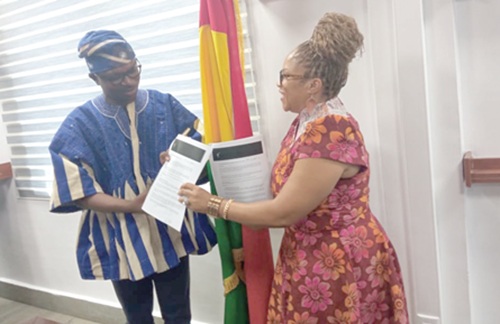
A youth development group, the Students Workforce and Innovation Movement (SWIM), and the National Entrepreneurship and Innovation Programme (NEIP) have signed a memorandum of understanding (MoU) to equip young people with digital skills, mentorship and industry connections to help them establish businesses and access employment opportunities.
The partnership is expected to link students’ innovative ideas to practical business opportunities under an initiative known as SEED — Supporting Entrepreneurship and Enterprise Development — a programme being implemented by NEIP to prepare young people for employment and entrepreneurship locally and internationally.
SWIM is a global workforce ecosystem and initiative designed to connect students and young adults, aged 18 to 35, with verified, structured and paid corporate projects.
Its core goal is to bridge education and industry, linking academic learning with real-world market demands, focusing on Artificial Intelligence (AI) readiness, digital skills, emerging technologies and business leadership.
The Minister of Youth Development and Empowerment, George Opare Addo, who addressed the ceremony in Accra, said the collaboration was an important step towards equipping Ghanaian students with the skills, networks and opportunities needed to succeed.
He said although young people remained the country’s greatest resource, talent alone was not enough to create jobs.
“Young people need relevant skills, mentorship, professional networks and access to opportunities to turn their ideas into viable businesses,” the minister said.
Turning ideas into businesses
Mr Opare Addo said the government had set a target of training 5,000 students annually under the Students Entrepreneurship and Enterprise Development (SEED) programme, beginning with 36 tertiary institutions.
He explained that the programme was designed to help students transform innovative ideas developed in school into viable businesses, instead of allowing them to remain as academic projects on shelves.
He said SEED was built on the achievements of the Dreamers programme, launched by President John Dramani Mahama, which had trained more than 10,000 young entrepreneurs across the country.
Mr Opare Addo urged students who would benefit from the programme to take the opportunities seriously, embrace innovation and remain resilient in the face of challenges.
“Let this MoU be more than a document on a shelf,” he said, adding that its success should be measured by the businesses students established, the jobs they created and the lives they transformed.
Partnership for digital opportunities
The Chief Executive Officer of SWIM, Louv Ford, said the agreement represented a commitment to connecting young people’s talents with meaningful opportunities.
She said SWIM had begun collecting data to facilitate the enrolment of young people in the programme and help them build careers in technology.
The initiative seeks to enable students to apply skills in emerging fields such as artificial intelligence, automation and blockchain technology to real business needs. Ms Ford said young people should not be spectators in the development of technology but active participants in creating solutions and shaping the future.
She called on members of the Ghanaian diaspora to contribute expertise, professional networks and resources to support students.
Such contributions could include mentorship, providing paid projects, connecting students to businesses and supporting training.
Call for stakeholder support
The CEO of NEIP, Eric Adjei, said the collaboration aligned with the agency’s commitment to helping young people benefit from government entrepreneurship programmes, particularly SEED.
He said that NEIP was ready to collaborate with SWIM to achieve success.
he Global Ambassador for SWIM, Clinton Arko Agyemang, called on government institutions, private individuals, businesses and industries to support the initiative to extend its reach and impact.
“The best resource that we have on the continent of Africa is not gold.
The best resource is the young people,” he said.
Mr Agyemang said SWIM’s digital model had the potential to generate significant employment opportunities, and stated that its current set-up could support at least 20,000 jobs every month.
