
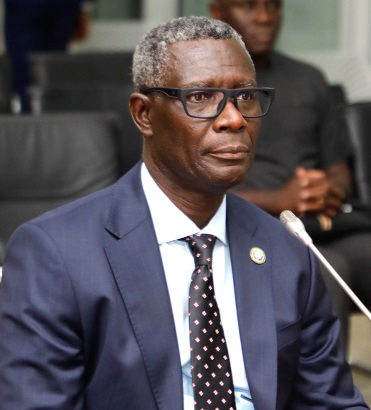
A nominee to the Supreme Court, Justice Edward Amoako Asante, has opposed the idea of a separate Bail Act, insisting that the country already has adequate legal provisions to guide the grant of bail.
He explained that the existing legal framework and judicial decisions had already made clear the principles and parameters governing the granting of bail, negating the need for a separate Bail Act.
“I do not think that is necessary in our circumstances.
Act 30 is a clear Act. It is there.
Then, to reinforce, there is Martin Kpebu and Attorney General.
That said, all the matters are available. Therefore, it is there. It is people who are lawyers who have not sued those who have detained their people beyond their time on behalf of their clients,” he said.
Justice Asante made the remarks when he appeared before the Appointments Committee of Parliament yesterday for vetting following his nomination by President John Dramani Mahama to serve on the Supreme Court.
He said the more pressing concern was the unlawful detention of suspects beyond the constitutionally mandated 48 hours, and urged lawyers to take legal action against persons and institutions that violated the rights of suspects, stressing that successful court actions and awards against offenders would deter such violations.
On judicial independence, Justice Asante said judges must possess an “independence of mind” and decide cases strictly on the facts and the law, regardless of who appointed them.
He then urged judges to recuse themselves from cases where personal relationships could compromise their conscience or impartiality.
Touching on spousal property rights, the nominee traced the country’s jurisprudence from the historical requirement for substantial contribution to the current emphasis on equitable sharing.
Justice Asante said the courts, through judicial activism, had developed the law after Parliament failed to enact legislation on the matter.
AI
On technology, Justice Asante described artificial intelligence (AI) as the way forward, and said its adoption could improve research and accelerate the handling of cases.
He, however, stressed the need for systems tailored specifically to Ghana’s judiciary and supported by adequate funding.
Justice Asante rejected suggestions that AI could eventually replace lawyers and judges, arguing that human thinking remained unique.
He said while AI could support legal research and other routine work, lawyers and judges would still have to verify and exercise judgment over the information produced.
Justice Asante opposed proposals to separate the judicial and administrative functions of the Chief Justice, saying both responsibilities were integral to the office.
He argued that the Chief Justice should retain responsibility for administrative decisions, including the empanelling of judges, rather than delegating such decisions to machines.
Justice Asante further distinguished between the fundamental human rights contained in Chapter Five of the Constitution and the Directive Principles of State Policy under Chapter Six.
He said the former generally protected individual rights and were enforceable, while the latter dealt largely with broader social and economic objectives.
He said some of the principles under Chapter Six could become enforceable where they were reflected in other provisions of the Constitution, but maintained that the two chapters served different purposes within Ghana’s constitutional framework.
Prior objection
Prior to the commencement of the vetting process, the Minority, led by Alexander Afenyo-Markin, objected to the vetting of Justice Asante and the two other Supreme Court nominees on the grounds that the nominations had been made in the absence of a vacancy at the apex court and that certain constitutional procedures had also not been followed.
However, the Chairman of the committee, Bernard Ahiafor, dismissed the objection, stating that the parliamentary recall expressly covered the nominees and that the committee had authority to proceed with their vetting.
“I, therefore, consider all grounds of the Minority Leader as flimsy and hollow.
I consider his objection to be frivolous, vexacious and unmeritorious, baseless on the facts, the rules and the law.
Therefore, I will accordingly dismiss the objection by the Minority Leader,” the chairman said.
The minority then staged a walkout and refrained from taking part in the vetting process.
