
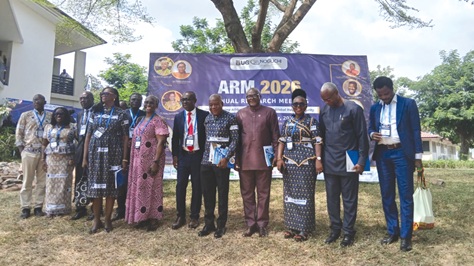
African researchers must be supported to lead research programmes and define research priorities, the Pro Vice-Chancellor, Research, Innovation and Development at the University of Ghana, Professor Samuel Nii Ardey Codjoe, has said.
He stated that while international collaborations remained essential, they must be built on reciprocity, shared responsibility, and a fair distribution of opportunity, resources, recognition and ownership.
“We should aspire to partnerships in which African institutions are not simply sites of recruitment or data collection, but strategic partners,” he advised.
Professor Codjoe further called on African countries to strengthen and sustain their research capacity by enabling their researchers and institutions to increasingly become producers, owners, and drivers of the research agenda that shapes the continent and affects its people.
Prof. Codjoe made the call at the opening of the Annual Research Meeting (ARM) of the Noguchi Memorial Institute for Medical Research (NMIMR) in Accra.
ARM
The ARM is one of NMIMR’s flagship events, bringing together scientists, researchers, students, development partners, policymakers and other stakeholders to present research findings, exchange knowledge and foster collaborations that advance scientific discovery and contribute to societal development.
It provides an important platform for showcasing research innovations, highlighting emerging public health priorities and strengthening the role of African-led research in addressing health challenges locally and globally.
This year’s meeting, which is being held on the theme, “Strengthening African-led Research for Global Health Security,” attracted a large number of abstracts, 258 of which were accepted from 12 countries and territories.
These comprise 38 oral and 220 poster presentations. More than 70 per cent of the research works are by young people aged between 20 and 30.
Prof. Codjoe, who was speaking on behalf of the Vice-Chancellor of the University of Ghana (UG), Professor Nana Aba Appiah Amfo, said African countries often bore a disproportionate burden of infectious diseases, while many of the resources, technologies and decision-making structures shaping the research response remained concentrated elsewhere.
This imbalance, he pointed out, was not sustainable, and Africa could not continue to be primarily a consumer of knowledge generated elsewhere.
He said African research must move beyond academic journals and conference presentations, and added that the knowledge they generated must become the evidence that informed policy and improved the way health care was delivered in the country.
“Our research must continue to improve diagnosis and treatment while supporting effective disease prevention, preparedness and response. Ultimately, the true measure of our research should be its contribution to improving health outcomes and the well-being of our communities,” he said.
He said the university recognised that its ambition for global impact could only be realised through strong institutions, skilled and dedicated personnel, and an enabling research environment.
He added that it remained committed to supporting NMIMR and other research institutions in pursuing work of national importance and international relevance.
The Director of NMIMR, Professor Dorothy Yeboah-Manu, said the theme highlighted the need for Africa to take a more active role in identifying its health priorities, shaping its research agenda and developing solutions that responded to the needs of its people.
Making reference to various disease outbreaks that had occurred in the country, including Yellow Fever, Marburg, Cholera, and M-pox, she said they were reminders that for Africa to achieve its own health sovereignty, it needed to strengthen research led from Africa.
“For far too long, research conducted on the continent has largely been shaped by priorities and funding decisions made elsewhere. It is time for us to develop our own questions that will answer the needs of our population,” she said.
The Japanese Ambassador to Ghana, Hiroshi Yoshimoto, said the relationship between Japan and NMIMR was a special one rooted in history and sustained by a shared commitment to improving health.
He said the cooperation went back to the time when Ghana requested Japan's assistance in strengthening medical research, particularly in the area of infectious diseases.
“This cooperation is rooted in the establishment of NMIMR in 1979 through JICA.
Since then, the government of Japan through JICA has remained a partner of the institute's growth through infrastructure, technical cooperation, and academic exchanges between Japanese and Ghanaian researchers.
Next year would mark 100 years of Japanese doctor Noguchi’s arrival in Ghana,” he said.
Other speakers at the programme were the Director for Science and Technology of the Ministry of Environment, Science and Technology, Kwamena Essilfie Quaison, who spoke on behalf of the sector minister, Dr Zanetor Agyeman-Rawlings; an associate professor and Head, Department of Immunology and Vaccine Biology, Professor Kwadwo Asamoah Kusi; and the officer in charge, WHO, Dr Frank Lule.
