
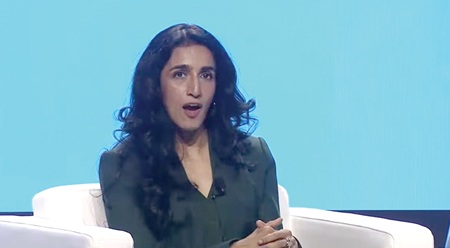
Artificial intelligence (AI) tools could undermine children’s academic performance when used to complete homework without a proper understanding of the subject, a global AI expert, Dr Ayesha Khanna, has warned.
Dr Khanna, who is the Co-Founder and Chief Executive Officer (CEO) of Addo, a global AI solutions firm, explained that the latest global research suggests that students who used AI to complete their homework performed nearly 24 per cent worse in subsequent examinations.
The expert stressed that excessive reliance on AI could weaken children’s ability to retain knowledge, formulate arguments and defend their ideas independently.
At a session of the ongoing annual meetings of the International Monetary Fund (IMF)/ World Bank in Bangkok, Thailand last Monday, Dr Khanna called for education systems to teach children how to use AI effectively while preserving their critical thinking skills and ability to learn independently.
“Students who rely on AI to do their homework may complete the task, but they are not necessarily learning the material needed to succeed in exams.
“Poor exam performance is often the result when students use AI as a substitute for learning rather than as a tool to support their understanding,” she said.
The session, titled “AI: Unlocking our human potential,” was held as part of the annual meetings of the International Monetary Fund and the World Bank Group, bringing together approximately 18,000 delegates, including central bankers, finance and development ministers, private sector leaders, civil society representatives, and academics.
The meetings addressed pressing global challenges, such as economic growth, rising public debt, geopolitical tensions and conflicts in Ukraine and the Middle East, climate resilience, and digital public infrastructure.
Against this backdrop, the session explored the transformative potential of artificial intelligence, particularly its implications for the future of work, employment, and the enhancement of human capabilities.
AI should support, not replace
Dr Khanna stressed that students must be taught to use artificial intelligence as a tool to enhance their understanding rather than as a shortcut to completing academic assignments.
She said while AI could help learners access information and solve problems, relying on it to generate answers without engaging with the material could undermine their ability to think independently.
She called for schools and universities to combine AI literacy with strong foundations in core subjects, enabling students to understand the principles behind the answers generated by AI systems.
Critical thinking in schools
The AI expert stressed the importance of encouraging students to question information, formulate their own arguments and defend their ideas through evidence and reasoning.
Drawing on her own educational experience, Dr Khanna maintained that learning to question established ideas and engage in rigorous debate had helped shape her into a more independent thinker.
She advocated teaching approaches that focused on solving real-world problems, such as climate change and poverty, while equipping students with both the foundational knowledge and AI skills needed to analyse complex issues.
She cautioned that without such changes, young people risked entering the workforce with technological skills but insufficient capacity for independent judgement and critical analysis.
Rethinking education for AI era
Dr Khanna urged education policymakers to redesign learning systems to prepare students for a labour market increasingly shaped by artificial intelligence.
She stated that the challenge was not simply to introduce AI into classrooms, but to ensure that its use strengthened students’ intellectual capabilities and prepared them to work effectively alongside the technology.
She added that balancing AI adoption with independent learning would be essential to unlocking human potential and ensuring that the next generation could adapt to technological change without losing the ability to think for themselves.
