
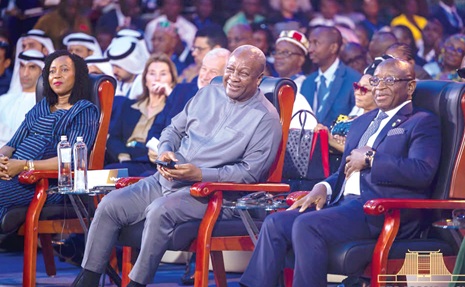
President John Dramani Mahama has urged West African governments to move beyond rhetorics and take concrete actions to remove trade barriers, invest in critical infrastructure, and ensure the continent’s mineral wealth benefits the people.
He said the time had come for ECOWAS to become “an ECOWAS of the people” rather than a gathering of Heads of State.
“For many years, ECOWAS remained at the level of Heads of State. And anytime we heard about ECOWAS, it’s because there was a summit and our leaders were meeting.
The time has come for us to own ECOWAS,” the President added.
He was addressing the inaugural West Africa Integration and Investment Summit (WAIIS) in Freetown, Sierra Leone, last Tuesday.
The summit was convened by Sierra Leone’s President, Julius Maada Bio.
In attendance were President William Ruto of Kenya, President Faure Gnassingbé of Togo, ministers, investors, development finance institutions, and business leaders.
It is aimed, among other objectives, at connecting regional priorities with capital and investment-ready opportunities.
President Mahama commended President Bio for operationalising the summit, saying that regional leadership “goes beyond tenure.”
Unfulfilled promise
The President also expressed frustration over the failure of the ECOWAS Trade Liberalisation Scheme (ETLS), passed in 1990, to deliver seamless trade across the sub-region.
He noted that intra-West African trade remained stagnant at between 12 and 15 per cent, decades after the scheme was adopted.
“Try to move goods from Freetown to Accra, and you will regret it and never try again.
Try to move goods from Accra to Lagos; you will get so frustrated that you will not try again,” the President added.
He blamed non-tariff barriers, citing the example of Nigerian authorities who demand NAFDAC certification from traders already holding valid ETLS certificates.
“Until we take the difficult decisions to open the highways, we will continue to assemble every year and talk about this,” the President said.
Economy
On the economy, President Mahama called for macroeconomic stability, predictable exchange rates, the rule of law, and infrastructure development to attract private capital.
“You cannot have investment when your currency is depreciating every hour. You cannot have investment when inflation is at 50 per cent.
You cannot have investment when your interest rates are going through the roof,” he said.
The President acknowledged the contributions of prominent African business leaders such as Tony Elumelu and Aliko Dangote, and urged financial institutions such as the Africa Finance Corporation and the African Development Bank to provide low-interest capital for execution of projects.
Transformation
President Mahama further outlined four critical areas that require urgent investment: agriculture, minerals, power and logistics.
He decried West Africa’s status as a net food importer despite its vast arable land, and said Ghana alone imported $3 billion worth of food annually, including rice and poultry.
Quoting Aliko Dangote, the President said: “Any time you use an imported product, you’re exporting value and bringing poverty back home.”
He also called for greater sovereignty over the continent’s mineral wealth, citing Ghana’s Gold Board initiative as a success.
“African minerals must be a source of wealth and prosperity for African people.
We did not put the gold there; God gave it to us.
The diamonds, God gave them to us.
And our people must benefit from that,” the President said.
On power, President Mahama said that only 7 per cent of electricity was exchanged among West African countries under the West African Power Pool, despite the potential to share excess power, adding that “you cannot industrialise when you do not have affordable power.”
The President also recalled that the Abidjan-Lagos corridor was mooted in 1998-99 when he was a young minister.
“Today, I am pushing 70, and the Abidjan-Lagos corridor is still on the drawing board.
That is why I say integration is still hanging up a pie in the sky,” he said.
On the proposed ECO common currency, President Mahama proposed a pragmatic approach which would allow willing countries to let ECO run side by side with their national currencies for trade settlement, rather than waiting indefinitely for all 15 ECOWAS member states to meet the convergence criteria, saying, “it is like waiting for Jesus Christ to come back.”
