
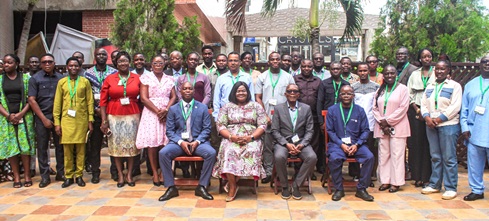
Stakeholders in Ghana’s forestry and farming sectors have met at a national dialogue to discuss how to produce and sell farm and forest products without destroying forests and have also discussed ways to help young people prepare for new international trade rules.
The dialogue was also aimed at strengthening the country’s preparedness for the European Union Deforestation Regulation (EUDR), which is a set of rules requiring certain commodities such as cocoa and cashew entering the European market to be traceable to establish that they have not contributed to deforestation.
The dialogue, held on the third day of a four-day capacity-building programme, brought together representatives of the Forestry Commission, the Ghana Cocoa Board, the Alliance for a Green Revolution in Africa (AGRA), the Food and Agriculture Organisation (FAO) and youth groups to discuss strategies for promoting sustainable production while protecting forest resources.
The National Dialogue, dubbed “Deforestation-Free Green Value Chains in Ghana: Pathways for Youth Employment and Sustainable Land Management”, was organised in Accra yesterday by the African Forest Forum (AFF) in partnership with AGRA and the Forestry Commission.
Practical measures
The Executive Secretary of the AFF, Professor Labode Popoola, said the EUDR was intended to discourage agricultural practices that destroyed forests and encourage production systems that allowed farming and forest conservation to coexist.
“So the idea was to discourage deforestation in planting cocoa, discourage deforestation in planting cashew and other products that come to the EU market,” he said.
Prof. Popoola said the implementation timelines for the regulation for large operators had been moved to December 30, 2026, while that for small operators was expected to be June 30, 2027.
He said the national dialogue was, therefore, an opportunity for stakeholders to examine the challenges and determine the next steps towards building sustainable and deforestation-free value chains.
He called for stronger collaboration among government agencies, development partners, industry players and young entrepreneurs to ensure that the transition to deforestation-free production was inclusive.
Youth-led businesses
The Country Director for AGRA, Dr Betty Simawua Annan, said AGRA was committed to supporting the development of a practical national roadmap, promoting youth-led businesses in traceability services and ensuring that women and smallholder farmers had a voice in shaping deforestation-free value chains.
She said AGRA was proud to support, through a grant to the African Forest Forum to scale up a youth-led climate innovations for a greener Africa project, which was currently being implemented in Ghana, Kenya and Ethiopia.
She said the project aimed to train 3,000 young people and women in business skills, support more than 30 youth-led enterprises and help each of the three countries develop a national roadmap by the end of 2027.
Institutional coordination
The Chief Executive Officer (CEO) of the Forestry Commission, Dr Hugh Brown, said the country was strengthening its institutions and traceability systems to ensure that commodities exported to the European market met applicable requirements.
The Food and Agriculture Organisation (FAO) Country Representative for Namibia, Edward Kilawe, also called for deliberate efforts to integrate young people into the country’s deforestation-free value chains as their skills and technological expertise could help address compliance challenges and promote sustainable forest management.
