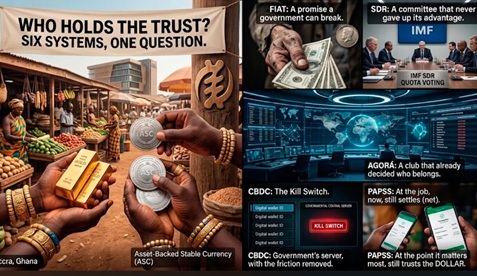
Every monetary system, however advanced its technology, is answering one blunt question: who does the world trust to say this is worth something?
Ask that question honestly of six systems currently competing for Africa’s future and an uncomfortable pattern emerges: five of them ask Africa to keep trusting someone else.
Fiat currencies trust in a promise a government can break whenever convenient.
The dollar commands 57 per cent of global reserves this year, not because it is backed by anything, but because dollar contracts are enforced by courts people trust, dollar debt is absorbed by markets deep enough to matter, and the network effect of everyone already using it makes switching costly for everyone at once.
That is real strength: unmatched liquidity and universal acceptance.
It is also the entire problem.
In August 1971, the United States unilaterally broke its own promise to convert dollars to gold, because it no longer could.
No accountability followed.
No return to discipline followed.
Every dollar issued since has been backed by nothing but the same institution’s word, the same institution that already broke that word once when it became inconvenient.
SDR trust in a committee that never gave up its own advantage
The IMF’s Special Drawing Right was sold as neutral: a basket, not a national currency, immune to any single country’s self-interest.
Look at who actually controls its allocation and the neutrality dissolves: quota-weighted voting still favours the same economies that already dominate fiat reserves.
The SDR did not remove the old privilege.
It relocated it into a technocratic committee room where Africa still holds no meaningful vote, and called the relocation reform.
Agorá trust in a club that has already decided who belongs.
The BIS’s tokenised settlement initiative is genuinely impressive engineering: in July 2026 it settled real money roughly 800,000 Swiss francs across seventeen scenarios in six currencies, each transaction clearing in under two minutes instead of days.
More than 40 institutions and central banks from the US, EU, UK, Japan, Switzerland, South Korea and Canada are building it right now.
Not one African central bank sits at that table.
This is not a future risk to warn against; it is happening today, with the rules of the next fifty years of global settlement being written in real time by the same guest list that excluded Africa from Bretton Woods in 1944.
Faster rails on an unchanged ownership structure is not progress.
It is the identical asymmetry, now running at the speed of light.
CBDCs trust in a government’s server, with the friction removed
Central bank digital currencies digitise fiat and add programmability and total visibility.
A government that can freeze a bank account today could freeze a digital wallet instantly and completely tomorrow, without the delays and paperwork that physical cash and correspondent banking still impose.
For economies that have already watched political power get abused across short electoral cycles, a programmable currency under direct state control is not obviously a step toward freedom.
It is fiat with a kill switch built in from day one.
PAPSS proves Africa can build without permission, and proves the job isn’t finished.
This is the one system on this list Africa actually built for itself, and it deserves to be said plainly: nobody invited Africa into PAPSS.
Africa built it anyway.
Fifteen central banks are now signed on, transactions clear in under two minutes in local currency, and costs have dropped by as much as 70 per cent compared to routing through correspondent banks abroad.
That single fact should retire, permanently, the excuse that nothing can move without a Western invitation.
But look at what happens underneath the local-currency surface: each day, when currencies are netted against each other, the residual imbalance between central banks still settles in hard currency; still, overwhelmingly, the dollar.
PAPSS solved the friction on the front end. It did not solve the deeper question of what asset two African institutions trust when their own currencies don’t yet trust each other.
That gap is real; it is measured in every day’s settlement report, and it is precisely where the next system has to be built.
AFP, under ASC, governed through ARB trust in a physical asset under African custody, answerable to no one else’s calendar.
This is a different category of answer.
The Ashanti Financial and Industrial Protocol’s founding thesis is uncompromising: fiat is only ever a medium of exchange, never wealth itself; real wealth is durable, productive, and physical land, gold, mineral rights, factories.
The Asset-Backed Stable Currency puts that thesis to work at the monetary layer, gold-and-silver-backed, priced openly against the same world benchmarks any counterparty can independently verify, but governed entirely through the Ashanti Royal Bank’s own Conversion Mandate rather than any foreign central bank’s rulebook.
It requires no seat at Agorá’s table, no vote inside the IMF’s quota system, no fifteen governments staying politically aligned through their own election cycles to keep functioning. It does not wait to be invited. It is already moving.
What this comparison actually establishes precisely, not triumphantly
Not that AFP is the only conceivable path; PAPSS proves state-led African infrastructure can be built without asking anyone’s permission, and that achievement stands on its own.
What AFP under ASC offers is the one thing every other system on this list still lacks.
Fiat asks you to trust an issuer’s restraint, and 1971 already answered whether that restraint holds.
SDR asks you to trust a quota-weighted committee that has never once voted against its own founders’ interest.
Agorá asks you to trust a club that has spent eighteen months building infrastructure without extending you an invitation to help design it.
CBDCs ask you to trust a state with a switch it can flip on your account without your consent.
PAPSS still asks you, at the point it matters most, to trust the dollar it was explicitly built to escape.
ASC asks something smaller and harder to break: that gold, priced in the open, checked against the same benchmark the entire world already uses, will still be gold tomorrow.
That is not a claim of instant victory; the renminbi has spent over a decade backed by the largest manufacturing base on earth and still holds under two per cent of global reserves, because trust takes years to earn and one broken promise to lose.
But of the six systems compared here, it is the only one built to answer the actual question on Africa’s own terms, rather than waiting, again, for permission from the people who have spent eighty years deciding the answer for everyone else.