
SEND Ghana, a Ghanaian policy research, advocacy and development organisation, has called for intensified education on Ghana's child labour laws to help eliminate child labour in cocoa-growing communities and safeguard the country's cocoa industry.
The organisation said although many cocoa farmers understood the difference between acceptable child work and child labour, significant gaps remained in their understanding of the law, making continuous community education critical.
It also called for stronger collaboration among the government, civil society organisations and the private sector to build platforms that work to remove all forms of child labour in communities.
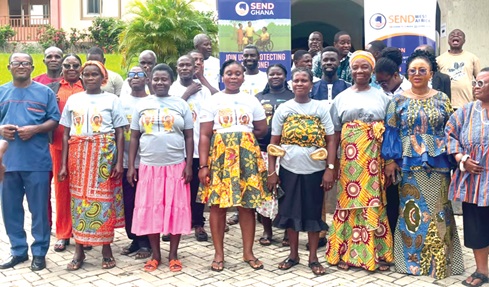
The call was made at a regional dialogue on child labour in Cape Coast organised by SEND West Africa/SEND Ghana under its project, "Addressing Child Labour through Knowledge Enhancement and Gender Model Family Approach in Ghana", funded by DKA-Austria.
The dialogue brought together cocoa farmers from Jukwa and the Hemang Lower Denkyira District, policymakers, child protection institutions and other stakeholders to discuss practical measures to eliminate child labour in cocoa-growing communities.
Presenting the findings from SEND Ghana's project to address child labour, the organisation's Gender and Youth Development Officer, Mary-Anne Kamara, said the project's first phase revealed that many farming families did not fully understand what constituted child labour under Ghanaian law.
"Our first recommendation is to strengthen farmers' understanding of the law at the community level using language and examples they can easily relate to," she said.
Ms Kamara explained that while children could undertake age-appropriate light work that contributed to their development, hazardous activities that endangered their health, safety or education remained prohibited.
She noted that many farmers considered children's participation in farming as a way of training them to take over family farms, creating a disconnect between long-held cultural practices and the legal provisions on child protection.
She warned that addressing child labour had become even more urgent as international markets increasingly demanded cocoa produced without child labour.
"The European Union is tracking cocoa supply chains, and if cocoa is linked to child labour, it may not be accepted. It is, therefore, important that our farmers understand why child labour must stop," she said.
Project impact
Ms Kamara revealed that the project had so far trained 200 cocoa farmers and their families, established 21 Gender Model Families, strengthened Child Labour Monitoring and Remediation Committees and reached more than 10,000 people through community radio discussions in the Jukwa and Twifo Praso cocoa districts.
Awareness
The Central Regional Director of the Department of Gender, Richlove Amamoo, said many child labour cases persisted because some parents were unaware that Ghana's laws protected every child regardless of family relationships.
"Some parents believe that because the child belongs to them, they can use the child on the farm. That is why education on the Children's Act is so important," she said, urging participants to become advocates against child labour in their communities.
Enforcement
The Central Regional Director of the Commission on Human Rights and Administrative Justice (CHRAJ), Daniel Amossah, said the fight against child labour required both public education and strict enforcement of the law.
He said CHRAJ continued to collaborate with the National Commission for Civic Education (NCCE) and other institutions to educate communities while ensuring offenders were prosecuted.
Representing the Central Regional Director of Education, Alberta Arthur said child labour continued to contribute to absenteeism, lateness, poor academic performance and school dropout among pupils.
She identified harvesting cocoa, carrying heavy loads, weeding, climbing cocoa trees, handling sharp tools and exposure to agrochemicals as hazardous activities prohibited for children.
Change attitude
Some participants said the programme had changed their perception of children's involvement in cocoa farming.
A cocoa farmer, Diana Amoako, said the dialogue reminded her of her own childhood experience, explaining that excessive farm work denied her the opportunity to fully benefit from education.
"I now understand why children should be in school instead of spending long hours on the farm.
This education has really opened my eyes," she said.
Another farmer, Kwabena Essoun, said some parents had previously believed children should always assist on cocoa farms during the peak season simply because they were family members.
"Now we know education must come first," he said.
Similarly, Kwabena Ankomah said he had learnt that although children could assist with age-appropriate tasks, they should never be assigned work beyond their physical capacity or allowed to engage in hazardous activities.
Send Ghana
SEND Ghana is a Ghanaian policy research, advocacy and development organisation under the SEND West Africa network that works to promote good governance, social justice and equal opportunities for women, men and children.
The organisation partners government institutions, civil society organisations, development partners and local communities to influence policies and strengthen accountability in areas such as education, health, agriculture, social protection, gender equality and local governance.
