
Sponsors and participants in illegal mining activities in the Savanna Region are foreigners, a development that poses dire security challenges to the country, latest research by Conginta, an international non-governmental organisation (NGO), has revealed.
The Gold for Good (G4G) research project, funded by the European Union (EU) in the emerging mining corridor in the Savanna Region, established that the financiers of illegal mining were Mossi people from Burkina Faso, while the active miners were foreigners from Nigeria, Côte d'Ivoire, Burkina Faso, Mali and other West African countries.
A lead researcher of the project, Professor Ebenezer Owusu-Sekyere, cautioned that the impunity with which the foreigners were destroying land and water resources in the name of mining posed a security threat to the country.
He said the situation was particularly worrying because of the growing spate of extremist activities in the West African region.
"We are talking about the economic and environmental consequences of galamsey, but let us not forget that the security implications are even more dire for us as a country, and we need to be worried," he stressed.
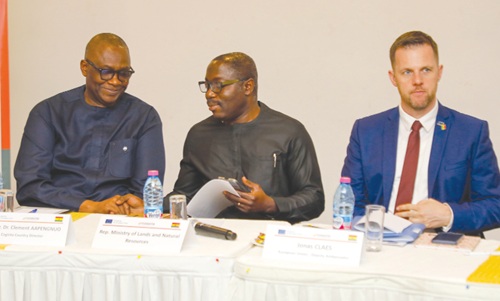
Prof. Owusu-Sekyere presented the findings of the research at the launch of the three G4G baseline studies in Accra yesterday (November 5) alongside Prof. Paul Nkegbe and Dr Dzigbordi Adzo Doke, all from the University for Development Studies (UDS).
Highlighting the key findings of the studies, Prof. Owusu-Sekyere said it had been established that unlicensed mining remained the greatest challenge to responsible small-scale mining in the area, as 97 per cent of miners operated without a licence.
"They do not agree to be referred to as illegal miners; they rather wanted to be called unlicensed miners because they were hopeful of receiving a licence some day," he added.
Additionally, the study found that about 74 per cent of illegal miners were unaware of regulations, despite widespread interest in formalisation. It also established that 45 per cent of illegal miners were willing to quit if the right economic support systems were put in place to guarantee them a sustainable livelihood.
The studies also revealed that there was excessive use of Cadmium and Mercury in volumes that exceeded safe limits in nearly all soil samples tested across communities in the Bole, Sawla-Tuna-Kalba districts that served as the hotbed for galamsey.
Again, the study found that limited regulatory oversight and predominantly cash-based gold transactions constrained traceability, adding that only a quarter of miners had bank accounts while 98 per cent of gold payments were made in cash.
Economic angle
Prof. Nkegbe said galamsey was rife in the area because it was a lucrative venture for the perpetrators.
“We found that the average annual household income is GH¢83,256 in mining communities against GH¢14,357 in non-mining communities – nearly six times – which is why exiting it is so hard,” he said.
For her part, Dr Doke said the baseline studies revealed that the soil had been heavily contaminated, with Cadmium exceeding the safe limit in all 49 samples and Mercury in about 94 per cent.
“Forest encroachment, rather than river pollution, emerged as the main driver of ecological risk – about 69 per cent of the nearly 1000 hectares mapped fell in the critical-risk category,” she added.
The E.U Ambassador to Ghana, Rune Skinnebach, said the G4G project was crucial because it would contribute to building a mining sector that was lawful, environmentally responsible, socially inclusive, and economically beneficial to communities.
The Deputy Minister of Lands and Natural Resources, Alhaji Dr Yusif Sulemana, said the baseline studies would be a useful source of material for effective policy formulation and evidence-based action to tackle galamsey.
