
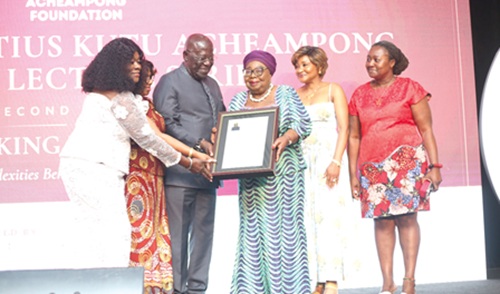
A statesman and business magnate, Sir (Dr) Sam Jonah, has credited a former head of state, the late General Ignatius Kutu Acheampong, for leading the return of control of the country's mineral wealth, industries and its regional development to Ghanaians.
Sir Sam said Gen. Acheampong's 1972 takeover of controlling stakes in the mines, his backing for indigenous industrialists and his creation of Regional Development Corporations gave Ghanaians, for the first time since colonial rule, a decisive voice over their own patrimony.
Dr Jonah was speaking at the Kutu Acheampong Lectures last Friday, on the theme "Breaking the Silence: The Human and Political Complexities Behind the Leadership of General Acheampong".
He declared that Gen. Acheampong "made Ghana's regions institutions that could invest in their own economies and he treated the leadership of those institutions as his national responsibility."
Regional development corporations
The business magnate said under the Regional Development Corporations, every region was to have its own corporation empowered to run agricultural, industrial and commercial ventures and to borrow within limits set by the centre.
Each board was chaired by the regional commissioner and included a chief nominated by the Regional House of Chiefs.
"Fifty years on, we are still asking how to give our regions and districts the means to build their own economies.
Acheampong asked that question early and he gave it an institutional answer," Dr Jonah said.
However, the tragedy, as he identified, was that when the economy weakened after 1975, the momentum drained away.
"The tragedy of Operation Feed Yourself is not that it failed, it is that it worked and we let it go.
Today, we spend some $2 billion a year importing food, with rice and chicken near the top of the bill."
Mining industry
In 1961, Sir Sam recalled, a commission recommended that the state owned at least 51 per cent of all mining companies.
Unfortunately, all governments prior to that period left that on the shelf until Gen. Acheampong’s regime.
In 1972, he said, the Acheampong government took controlling interest in Ashanti Goldfields, in the State Gold Mining Corporation and in the great foreign timber houses.
"For the first time since the Portuguese landed at Elmina, the majority of the wealth beneath Ghanaian soil belonged to Ghanaians," Jonah, who is a former Chief Executive Officer of erstwhile Ashanti Goldfields, said.
He explained that he did not send soldiers to seal the mines, but kept the foreign partners, their capital and expertise, and the management agreements.
Gen. Acheampong insisted on three things: that head offices be in Ghana, that the state held a controlling voice and that Ghanaians be trained and placed as deputy managers with a clear expectation that the top chair would follow,” he stated.
"So, when I stood on the floor of the New York Stock Exchange as Chief Executive of the first African company to list there, I was standing on the foundation laid in 1972 by Acheampong, who I will never forget," he said.
Today, Dr Jonah lamented that the country held zero per cent stake in AngloGold Ashanti, the successor company.
"We gave away not just the shareholding, but we gave away the principle.
The lesson of Acheampong is not that the state should own everything.
It is that a nation must never surrender the decisive voice over its own patrimony," he said.
