
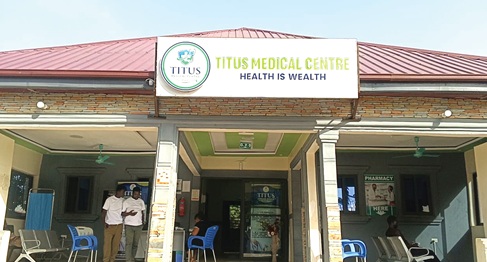
For farmers in the Kpandai District, a snakebite can turn an ordinary day on the farm into a fight for survival.
The cost of treatment and long journeys to distant hospitals can delay medical attention, particularly for families unable to afford urgent care.
For Daniel Manan, a farmer who suffered a snakebite, the absence of a facility to handle such occurrences poses a great challenge.
Recounting his experience, Daniel said he was once bitten while working on his farm but did not realise it until two days later when he began experiencing unusual reactions in his body.
He said he was rushed to Titus Medical Centre, where a doctor examined him and immediately started treatment.
“I am doing very well and have returned to my normal duties.
I can confidently say that without this facility and its workers, I would have died by now,” he said.
Mr Manan said he received medication and injections without charge, easing his initial fear that he would be unable to afford treatment.
He said many farmers faced similar financial difficulties and needed access to affordable emergency care.
At Kumdi, the Titus Medical Centre is offering a lifeline to victims by providing free snakebite treatment.
However, the high cost of antivenom threatens the sustainability of the initiative.
It also provides free medical services, including screening and care for hypertension and diabetes to persons aged 60 and above.
Snakebites threaten farming families
The Chief Executive Officer (CEO) of the Titus Medical Centre, Stephen Lee Demuyakor, in an interview with the Daily Graphic, said snakebites remained a major concern in the district because most residents depended on agriculture for their livelihoods.
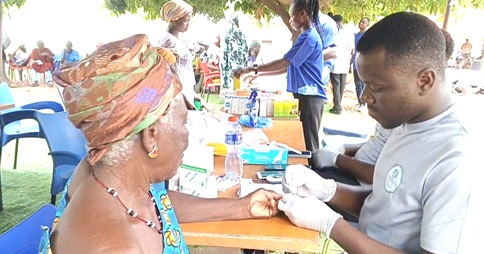
Medical personnel at Titus Medical Centre attending to patients aged 60 and above at the forecourt of the facility.
Farmers spend long hours on their farms, where encounters with snakes are possible.
Children who accompany their parents to the farms are also exposed to the danger.
Mr Demuyakor said the centre had treated victims from Loloto, Nyakata, Chamba, Quilbi-Quarters, Lonto, Kpajai, Kumdi, Tengelinto, Kojoboni, Bakamba, Wiai, among other communities.
He explained that the decision to provide free treatment was informed by the emergency nature of snakebites and the financial difficulties confronting many rural households.
“Nobody prepares to go to the farm and have a snakebite. We consider snakebite an emergency that we need to treat,” he said.
The CEO recounted the case of a four-year-old girl who was bitten while sitting among groundnut husks at a farm. Her parents had not realised that she had been bitten.
He said the facility had treated eight children under 15, including children as young as four.For farming households, seeking treatment can be particularly burdensome. Patients travelling to facilities in Kpandai or Salaga may have to pay for transport and medical care, while time spent away from the farm can affect household income.
Misconceptions about snakebites
Beyond treating victims, the medical team has embarked on community education to address misconceptions that may prevent residents from seeking prompt medical attention.
Mr Demuyakor said some people continued to associate snakebites with witchcraft or supernatural forces, potentially delaying access to appropriate treatment.
The centre has, therefore, visited remote communities to educate residents on the medical nature of snakebites and the need to seek professional help quickly.
“We educate the general public that snakebite is not witchcraft; it is not mystical.
It does happen and when it does, people must come forward quickly for treatment,” he said.
The education programme seeks to encourage residents to recognise snakebites as medical emergencies rather than rely initially on traditional or spiritual interventions.
Antivenom costs and treatment
Despite the centre's efforts, the cost of antivenom remains a major challenge.
Mr Demuyakor said the facility relied on personal funds and contributions from family members, friends and well-wishers to purchase antivenom and other medicines.
He said some antivenom products cost as much as GH ₵ 400 on the open market, while a patient could require three or more doses, depending on the clinical circumstances.
These expenses place considerable pressure on a facility that does not charge patients for snakebite treatment.
Mr Demuyakor appealed to the government, non-governmental organisations (NGOs), development partners and other donors to help secure a reliable supply of recommended antivenom for the centre.
He said sustained access to the medicine would enable the facility to maintain its free treatment programme and help prevent financial difficulties from delaying emergency care.
He called on the government and the Ministry of Health to explicitly include snakebite treatment, particularly the provision of antivenom in the Free Primary Healthcare policy to ensure that victims, especially those in deprived rural communities, could access timely treatment without financial barriers.
Free maternal care for rural women
Alongside snakebite treatment, the Titus Medical Centre provides free maternal healthcare to help women overcome the financial and transportation difficulties associated with accessing services in distant communities.
Mr Demuyakor said some pregnant women had to travel to Salaga, Kpandai and other areas to obtain care, increasing the cost and difficulty of attending appointments.
At the centre, management said pregnant women receive free antenatal consultations, ultrasound scans, laboratory investigations and antimalarial medicines. Women requiring closer observation were also admitted for monitoring without charge.
It has also established a pregnancy school attended by 30 women and their husbands at different stages of pregnancy to prepare them for childbirth.
Demand for rural healthcare
Mr Demuyakor said the centre's outpatient department had recorded nearly 2,000 patients between May and October 2026 with 1,200 being women and children.
However, the growing demand for its services has increased the pressure on its resources, particularly as management seeks to maintain free treatment for snakebite victims and provide maternal healthcare.
Many residents depend on subsistence farming and struggle to meet unexpected medical expenses.
Poor roads and long distances to hospitals further complicate access to care.
For the Titus Medical Centre, the challenge is to sustain services that many rural residents would otherwise struggle to afford.
A reliable supply of antivenom remains particularly important, given the urgency of snakebite treatment and the financial constraints facing farming households.
For farmers such as Daniel, the availability of timely, affordable treatment offers a chance to recover and return to their livelihoods without the additional burden of medical debt.
