
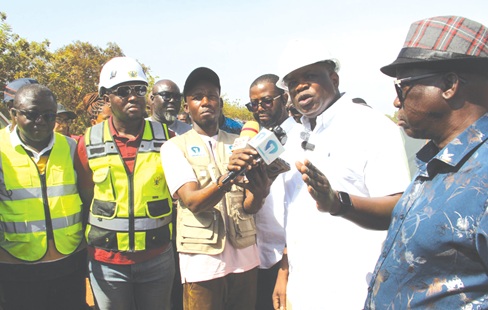
The Minister of Roads and Highways, Governs Kwame Agbodza, has directed the Ghana Highway Authority (GHA) to immediately introduce speed-calming measures along the Bolgatanga–Navrongo–Paga Highway in the Upper East Region to curb the spate of pedestrian knockdowns and attendant deaths.
He said the authority must install speed-calming measures, particularly around schools, hospitals and other built-up areas where pedestrian-vehicle accidents were frequent.
The temporary measures, he said, would help prevent avoidable deaths, especially among women and children, along the Trans-ECOWAS Highway, which connects Bolgatanga to the Paga border with Burkina Faso and is frequently used by speeding heavy-duty trucks.
Mr Agbodza gave the directive during an inspection of the affected stretch in Bolgatanga yesterday. He directed the GHA to deploy personnel to implement immediate traffic-calming measures by Monday, November 16, 2026
“We know that the road is planned for major rehabilitation later, but that time may be too late for somebody's life to be saved,” he said.
The directive followed appeals by the Upper East Regional Minister, Donatus Akamugri Atanga, and the Member of Parliament for Bolgatanga Central, Isaac Adongo, over repeated fatal accidents which they said had claimed between 10 and 20 lives recently.
Driver behaviour
While acknowledging the need for road safety measures, Mr Agbodza also identified driver behaviour as a major factor contributing to road accidents, citing records from the National Road Safety Authority (NRSA).
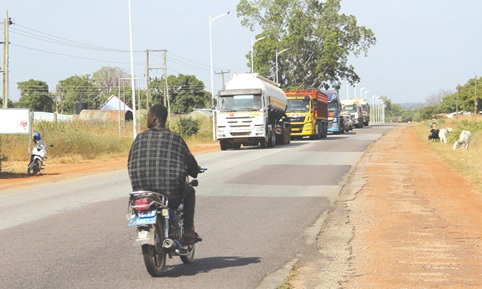
“The records from the National Road Safety Authority on the causes of road accidents clearly suggest driver error, and it is hardly the nature of the road itself,” he said.
He added that many motorists continued to disregard legally prescribed speed limits along the stretch, thereby putting other road users at risk.
He appealed to motorists, particularly drivers of heavy goods vehicles that frequently used the N10 corridor towards Burkina Faso, to observe speed limits and exercise caution when passing through communities.
The minister gave an assurance that temporary measures would be put in place to slow down traffic while the government worked towards a more comprehensive solution involving the rehabilitation of the entire road surface.
Earlier, the Upper East Regional Minister and the MP had briefed Mr Agbodza and his team on some of the hazards along the highway.
They said the Trans-ECOWAS Highway had become a major safety concern because of speeding motorists and frequent accidents involving pedestrians and other road users.
They consequently called for the introduction of the TraffiTech-GH system, a technology that uses fixed and mobile cameras, including equipment mounted on police vehicles, to capture traffic offences such as speeding.
They said the system, together with speed humps, would help reduce speeding and save lives in the affected communities.
The acting Upper East Regional Director of the GHA, Ernest Osei-Bonsu, said the authority had engaged residents to identify accident black spots and locations of particular concern.
For a stretch of about 8.3 kilometres, he proposed the erection of 10 speed-calming features with their accompanying signs to help drivers reduce speed on the stretch.
