
The Environmental Protection Authority (EPA) has said the protection of the coastline from the ravages of the sea must include mangrove restoration.
“Concrete walls alone will not save the coasts,” said the Volta Regional Director of EPA, Kosi Zu-Cudjoe.
Mr Zu-Cudjoe explained that reafforestation of the mangroves will significantly help to erect natural protective walls, trap the sand and nurse fish for the coastal communities.
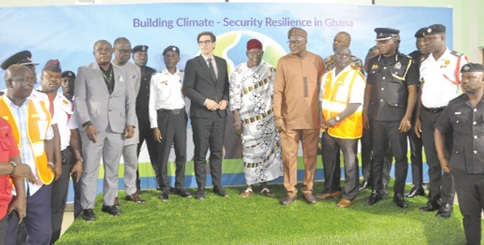
He said this at the 2026 Climate Talks organised jointly by the Embassy of the Federal Republic of Germany and TV3 at Tegbi in the Anloga District in the Volta Region last Wednesday.
About 100 people from security agencies, the National Disaster Management Organisation, community leaders, assembly members, civil society organisations, youth groups, peace-building organisations and students attended the one-day event.
The EPA Volta Regional Director, who was presenting a paper on ‘Building Climate-Security Resilience in Ghana,’ said saving the coast in the region from further degradation required a total ban on beach mining.
“We also need an early warning system that speaks Ewe on the radio and from the community information centres, before the waves come, and a resettlement plan that gives our displaced families land and livelihood, not tents in a coconut grove,” he added.
Meanwhile, Mr Cudjoe reminded the government and the Ghana Hydrological Authority to commit greater effort and resources towards completing the sea defence project from Anloga to Blekusu, saying “the cost of the concrete may be high, but the cost of losing 4,000 people through flood as happened in Keta in 2021 is higher”.
He warned that Ghana was losing about two metres of land every year to the sea and in Keta, Anloga, Fuveme and Agavedzi, the sea claimed seven to eight metres of land every year.
Mr Zu-Cudjoe, therefore, highlighted the need to dredge the Volta Estuary at Ada, explaining that when the estuary was choked with silt, the Keta Lagoon could neither breathe nor drain into the sea.
“So, it overflows onto our farms,” he pointed out.
German Ambassador
The German Ambassador, Frederik Landshoft, said in the Anloga and Keta areas, coastal erosion was a question of human security.
Entire parts of the once thriving trading town of Keta has disappeared into the sea; homes has been washed away; around 5,000 palm trees has been lost in recent times, and families haave to rebuild their lives, sometimes again and again, he said.
The envoy pledged his country’s commitment to continue studying the situation and helping to facilitate a change for the better, stressing the people most affected must have a central role in shaping the solution.
The German Ambassador said the people of Keta had shown extraordinary resilience over the years, but pointed out resilience alone could not hold back the sea.
He said addressing the situation required investment, scientific expertise and sustained cooperation.
Awadada of Anlo
The Awadada of Anlo, Togbe Agbesi Awusu II, who chaired the function, renewed his call on the government to take urgent steps to ensure the immediate implementation of the West Africa Coastal Areas Management Programme (WACA) in southern Volta, before the sea caused further havoc in the area.
“The programme has worked for immediate neighbours in the sub-region, so it will definitely work for us as well,” he said.
