
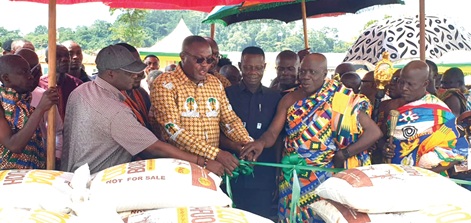
The Ghana Cocoa Board (COCOBOD) has relaunched the free fertiliser distribution programme, with a total of 3.5 million bags of granular fertiliser purchased for distribution to cocoa farmers nationwide.
Approximately 1.2 million bags have already been delivered to farmers.
In addition, the government has purchased 1.8 million litres of liquid fertiliser, 2.3 million litres of insecticides and 1.5 million kilogrammes of fungicides for the farmers.
The Chairman of the Board of Directors of COCOBOD, Dr Samuel Ofosu Ampofo, announced this at the relaunch of the programme at Sefwi Wiawso, Western North Region, on the theme: “Cocoa sector reset: Free fertiliser for increased productivity and improved farmer income.”
Significance
The chairman said the programme represented a comprehensive package of production and crop protection inputs designed to address some of the most critical constraints confronting cocoa farmers.
He said it was intended to improve soil fertility, strengthen the health and vigour of cocoa trees and ultimately increase yields, adding “the liquid fertilisers, insecticides and fungicides will complement these efforts by supporting plant nutrition and the effective management of major cocoa pests and diseases”.
“This is an investment in the productive capacity of our cocoa farms, the livelihoods of our farmers and the long-term sustainability of Ghana's cocoa industry.
While appealing to the farmers to make judicious use of the fertiliser and other agro-inputs being provided, Dr Ampofo also said: “You must adhere to recommended application rates and schedules, maintain your farms properly and cooperate with our extension agents”.
Not a handout
The Chief Executive Officer of COCOBOD, Dr Randy Abbey, said the programme was not a handout but an investment in farmers, in the soil and in the foreign exchange earnings of the nation.
“In the past, inputs meant for genuine farmers ended up in open markets, across our borders and on the farms of the well connected, while the smallholder farmer at the end of the line went home empty-handed,” he said.
The CEO said this time round, his outfit had built the entire distribution chain around a new digital input system that followed every bag or litre of input from the warehouse to the farm.
“Every beneficiary must be a registered farmer whose farm has been mapped and captured on our digital Cocoa Management System (CMS). And each farmer's identity is verified at the point of collection,” he said.
Dr Abbey warned that any officer, buyer or individual found diverting, hoarding, reselling or smuggling the inputs would be dealt with according to the law.
For his part, the Western North Regional Minister, Wilbert Petty Brentum, said the availability of fertiliser at no cost to farmers would support the rehabilitation of farms and improve the health and productivity of surviving cocoa trees.
The acting President, Sefwi Wiawso Traditional Council, Nana Ofori Ahenkan II, who chaired the function, urged the farmers to use the fertiliser for its intended purpose, while adhering to best agronomic practices to achieve results.
Appreciation
A representative of the Cocoa Coffee and Sheanut Farmers Association (COCOSHE), Nana Kwasi Ofori, said the initiative was a significant step towards the revitalisation of the nation’s cocoa sector and expressed appreciation for the programme.
“Access to fertiliser is critical to maintaining soil health, improving the nutritional conditions of cocoa trees and enhancing farm productivity.
“The programme will help ease the financial burden and encourage better farm management,” he added.
Writer’s email:
