
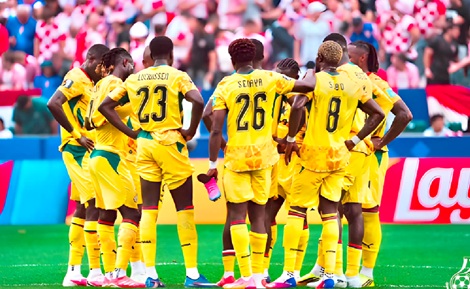
Even though Ghana may have reached the FIFA World Cup Round of 32, Carlos Queiroz knows the road to Kansas City is littered with defensive questions that demand urgent answers after Croatia exposed the Black Stars' vulnerability in a 2-1 defeat in the final Group L match at the Philadelphia Stadium last Saturday.
The veteran Portuguese coach dismissed the setback as "a lesson, not a failure", insisting that his players must learn quickly because "the real World Championship starts next game" against Colombia.
Already assured of qualification before kick-off, Queiroz's side finished the group phase with four points, placing third behind England and Croatia.
England's 2-0 win over Panama secured them the top spot, while Croatia recovered impressively from an opening-day defeat to claim second place with back-to-back wins.
The Black Stars' reward is a heavyweight knockout stages meeting with Colombia on July 4, after the South Americans held Portugal to a goalless draw in Miami, topping Group K with two wins and a draw.
It promises to be a far sterner examination, one the Black Stars know cannot be negotiated, given the defensive lapses that proved so costly against Croatia.
Reshuffled lineup
With qualification already guaranteed, Queiroz rested tireless midfielder Caleb Yirenkyi and first-choice centre-back Jerome Opoku, handing Derrick Luckassen his first appearance in a 4-1-2-3 system.
It was a calculated rotation, but one that inadvertently exposed the defensive cohesion Ghana had built during their opening two matches.
Against one of Europe's most accomplished midfields, orchestrated with customary authority by Luka Modrić, Ghana were repeatedly pulled out of shape as Croatia exploited the spaces between the lines with intelligence and patience.
Benjamin Asare once again produced a string of outstanding saves, but even the Hearts of Oak goalkeeper could not deal with the defensive frailties which unfolded in front of him.
After Nicola Vlašić squandered an inviting chance in the 16th minute, Croatia eventually made their dominance count. Peter Sučić found space just beyond the Ghana defence and drilled a fierce low shot beyond Asare after 31 minutes, rewarding Croatia's sustained pressure.
Attacking struggles
The goal reflected the balance of play. Croatia dictated possession and tempo, while Ghana struggled to establish attacking rhythm, with Antoine Semenyo providing the only consistent threat.
The Black Stars' final ball repeatedly lacked the precision required to trouble Dominik Livaković, leaving the Croatian goalkeeper largely untested before the interval.
Queiroz admitted afterwards that Croatia deserved their superiority in the opening period, acknowledging that his side had been punished for avoidable mistakes.
"We win or we learn," the Portuguese coach reflected. "Croatia played better in the first half and capitalised on our mistakes."
He was particularly frustrated by Sučić's strike, describing it as "not possible to concede" at this level of the competition.
Recognising that the tactical balance needed to change, Queiroz abandoned his initial shape at the interval, introducing Kojo Peprah Oppong and Abdul Fatawu Issahaku for Jonas Adjetey and Elisha Owusu before switching to a more aggressive 4-4-2 formation.
The Black Stars pressed with greater conviction, carried more bodies forward and finally began to ask questions of the Croatian defence.
Ernest Nuamah and Brandon Thomas-Asante added fresh attacking impetus after they replaced Kamaldeen Sulemana and Captain Jordan Ayew, whose influence had gradually diminished as Croatia controlled the midfield.
The tactical shift eventually paid off in the 72nd minute.
Nuamah delivered a cross from a free kick into the danger area, whereupon Luckassen reacted quickest to steer home his first international goal.
The celebrations were cut short when the assistant referee raised his flag, prompting a tense seven-minute VAR review before the equaliser was finally confirmed.
Defensive lapse
The momentum had swung, but only briefly. Nine minutes later, Ghana's defensive concentration deserted them again. Following another superb point-blank save by Asare, Croatia won a corner and once more exposed Ghana's inability to deal with set pieces.
Vlašić escaped his marker to power home the decisive header in the 81st minute, punishing another lapse in concentration that ultimately settled the contest.
Queiroz believed the second-half response showed the character his side would need in the knockout rounds, but admitted they failed to make their improved performance count.
"Our second half was much better after the change in system," he said.
"We created opportunities, but we didn't capitalise on them and at this level, you pay for every mistake."
The winning goal sparked wild celebrations among Croatia's supporters in the 68,324 crowd, but Queiroz refused to dwell on the disappointment.
Instead, he challenged his players to treat the defeat as a turning point.
"The real World Championship starts in the next game," he said.
"We win or we learn and today, we learn to be better prepared.
This match has given me a clear picture of the performance of some players and what we need to do differently in the coming games."
