
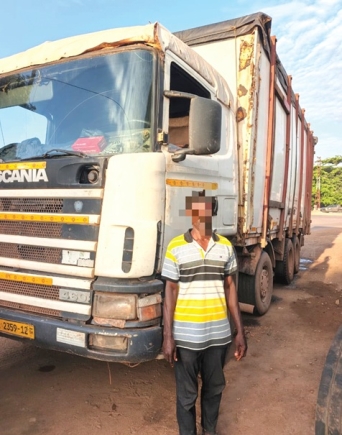
About seven months after the government imposed a 10-year ban on raw rubber exports, suspected attempts to smuggle the commodity out of Ghana persist, threatening the country's industrialisation drive, with serious concerns about compliance with the directive.
The Ghana Police Service and the Customs Division of the Ghana Revenue Authority (GRA) have, however, earned industry stakeholders' commendation for decisive, intelligence-led operations that resulted in the interception of substantial quantities of raw rubber suspected to be destined for illegal export.
In October, Customs officials, acting on intelligence, intercepted and seized four containers of raw rubber at the ACS yard at Tema Port as the commodity was allegedly being prepared for export.
In a separate operation within the same month, the Tema Regional Police Command intercepted an articulated truck carrying approximately 47 tonnes of raw rubber along the Accra-Tema Motorway.
Documents accompanying the consignment declared its weight as only 1,500 kilogrammes, although subsequent police weighing established approximately 47,000 kilogrammes — a staggering discrepancy of 45,500 kilogrammes that raises suspicions of fraud and possible underpayment of duties.
The documents also suggested that the rubber originated from Côte d'Ivoire, despite a ban on raw rubber exports in that country.
Significantly, the intercepted consignment was accompanied by a Tree Crops Development Authority (TCDA) conveyance certificate identifying Nsawam as its intended destination, although checks indicated no known rubber processing factory there.
Further arrests
In a different operation this month, the Tema Regional Police Command arrested two persons in connection with the suspected smuggling of 41,360 kilogrammes of raw rubber valued at approximately GH¢400,000.
The suspects claimed the commodity was intended for a processing factory at Tarkwa-Daamang, but that it had mistakenly been transported to Tema.
Both suspects have since been granted bail as investigations continue.
The successive interceptions have heightened concerns that suspected illegal movements of raw rubber are continuing despite the government's directive, with the police and Customs Division of the GRA increasingly becoming the frontline defence against the illegal trade.
TCDA's intervention
But the TCDA has stirred controversy with a request on the seized consignments.
Following its successful intelligence-led seizure, Customs initiated processes to auction the confiscated raw rubber to local processors.
However, in a letter dated November 20, 2026, TCDA Chief Executive Officer, Dr Andrews Osei Okrah, requested the suspension of the auction, payment, collection, and release processes involving six containers, including the four seized through Customs-led intelligence without TCDA's involvement.
The November 20, 2026 letter requesting the suspension of the auction was only written after Customs informed local rubber processors about the auction.
“Under the Tree Crops Development Authority Act, 2019 (Act 1010), TCDA is mandated to regulate and develop six strategic tree crops, including rubber. Consequently, the disposal and trading of rubber commodities require appropriate regulatory oversight to address traceability, compliance and other sector-specific concerns,” the letter stated.
However, under the Customs Act, 2015 (Act 891), as amended, the Customs Division has statutory powers relating to the seizure, forfeiture and disposal of goods, subject to prescribed legal procedures.
The intervention has raised serious questions among industry stakeholders about why the sector regulator would seek to suspend the disposal of consignments intercepted by Customs while enforcing the government's export ban.
TCDA described its request as a temporary measure pending further investigations and regulatory engagement.
Nevertheless, stakeholders maintain that the authority should strengthen intelligence sharing, traceability and enforcement rather than delaying the disposal of confiscated raw materials.
Critical test
The 10-year export ban, announced in April 2026, was intended to promote domestic processing, protect industrial investments, create employment and increase foreign exchange earnings through value addition.
Yet local processors continue to complain of raw material shortages and underutilised factory capacity, while suspected illegal export attempts persist.
The developments reinforce concerns raised in the Daily Graphic's March 31, 2026 investigation, headlined: “Under-invoicing rocks raw rubber exports”, which exposed discrepancies in export declarations and weaknesses in regulatory oversight.
Industry stakeholders have praised the police and Customs for their vigilance and determination, and called on lawmakers and policymakers to examine the continuing suspected violations in order to strengthen coordination among the institutions responsible for enforcing the ban.
