
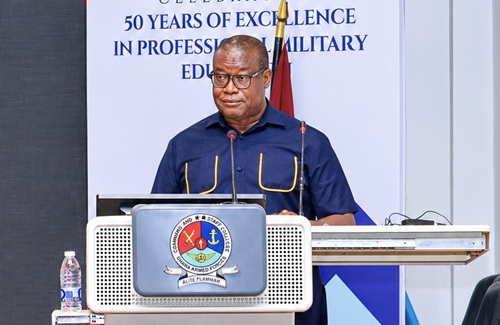
The Editor, Graphic, Theophilus Yartey, has urged the military to protect press freedom and respect the work of journalists, stressing that such commitment is essential for the protection of the constitutional order, strengthening democratic governance and promotion of national security.
He said the military’s responsibility to defend the constitutional order also required respect for the freedoms guaranteed under the Constitution, including freedom of speech and independence of the media.
Addressing officers of the Ghana Armed Forces Command and Staff College (GAFCSC) at a seminar in Accra last Monday, Mr Yartey said attempts to intimidate journalists, restrict access to public interest information or prevent coverage of public events undermined the transparency and accountability required for democracy to thrive.
He emphasised that the military and the media had complementary responsibilities in protecting the state and its people.
“In a democracy, we are not adversaries. We are two pillars holding the same roof. When one pillar attacks the other, the roof collapses on all of us,” he said.
The seminar was on the topic: “Legitimate Requirements of the Media and Its Importance to Democracy”.
It formed part of the training programme for Senior Course 48, which has 100 participants, comprising 67 officers from the Ghana Armed Forces and others from allied African countries, including Nigeria and Zambia.
Other speakers at the seminar were a journalist with the Ghana Broadcasting Corporation (GBC), Joyce Anim-Ayekoo; and Deputy Director of Corporate Affairs for the GAFCSC, Lieutenant Colonel Sena Affanyi.
Protecting press freedom
Mr Yartey said journalists needed an environment free of intimidation, unlawful arrests, physical attacks and other forms of interference to discharge their constitutional responsibilities.
He explained that the media was not demanding absolute freedom or immunity from accountability, but required adequate legal protection to publish and broadcast without fear.
Referencing Article 21 of the 1992 Constitution, Mr Yartey said freedom of speech and expression, including freedom of the press and other media, was constitutionally guaranteed.
He cautioned that attacks on journalists by security personnel, even when undertaken with good intentions, could erode public confidence in the state.
“When soldiers assault journalists, even with good intentions, the message to 30 million citizens is that the state is afraid of the truth. That erodes trust in the very state you defend,” he said.
He said the military must recognise that journalists performed an important public service by documenting events, questioning public officials and providing citizens with information to hold institutions accountable.
Access to information
On access to information, Mr Yartey said journalists needed timely access to public interest information to report accurately on the activities of state institutions, including the military.
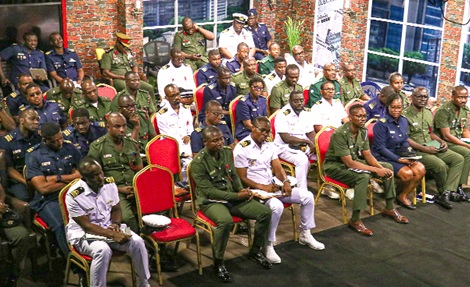
A section of the soldiers
He clarified that the media was not demanding access to classified operational secrets but information whose disclosure served the public interest.
He cited Ghana’s Right to Information Act as an important tool for journalists, and commended the Directorate of Public Relations of the Ghana Armed Forces for its cooperation with the media.
The Editor, Graphic, also called for reasonable media access to Parliament, the courts, press briefings and non-sensitive military exercises and humanitarian operations.
He said such access would help the public to understand the work of state institutions and strengthen confidence in their operations.
Mr Yartey acknowledged the military’s concerns about operational security, accreditation and ground rules for media coverage but said restrictions should be guided by legitimate security considerations.
He further identified the protection of journalistic sources and editorial independence as important requirements, warning that media organisations controlled by political or commercial interests risked losing credibility and becoming propaganda platforms.
A Senior Lecturer at the University of Media, Arts and Communication (UniMAC), Dr Tim Quashigah, said media freedom must be accompanied by responsibility and accountability to ensure that journalism contributed positively to democratic governance.
He said the media played an important role in raising public consciousness about democratic principles through political discussions and public education across radio, television and social media platforms.
Dr Quashigah explained that journalists had a responsibility to report accurately and fairly, adding that freedom of expression did not give media practitioners the licence to publish misleading or biased information.
“The media must first of all be free, grounded in their independence, grounded in constitutional provisions which protect them and insulate them in a way from political influence, ideological influence, commercial influence and other influences. But that freedom should come with responsibility,” he said.
Balancing media freedom, security
The Deputy Director of Corporate Affairs of the GAFCSC, Lieutenant Colonel Sena Affanyi, said information, public perception, communication and institutional legitimacy had become important determinants of military operational success.
She said contemporary security challenges were no longer confined to traditional military domains, as the information environment had become an important theatre of influence.
Lt Col Affanyi explained that the media played an influential role in shaping public opinion, influencing political decisions and determining how military operations were understood by society.
She said military commanders must, therefore, develop professional relationships with journalists while protecting operational security, sustaining public confidence and upholding democratic principles.
