
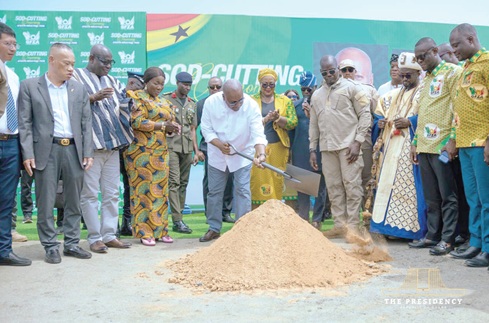
President John Dramani Mahama yesterday cut the sod for the Afienya Industrial Park, a 1,238-acre development designed to accommodate more than 120 enterprises and position Ghana as a manufacturing and logistics hub for the West African sub-region.
The ceremony, held under the auspices of the Ghana Free Zones Authority (GFZA), marked the commencement of a project expected to provide serviced plots, ready-to-use factory shells, and essential infrastructure for investors.
Present were the Minister for Trade, Agribusiness and Industry, Elizabeth Ofosu-Adjare, Ghana’s Ambassador to the United States of America, Victor Smith, the Chief Executive Officer (CEO) of the GFZA, Mary Awusi, some captains of industry and industrial workers.
Purpose
Addressing the gathering, President Mahama said the project was a direct response to the growing demand for industrial space in the country.
He revealed that the decision to establish the park was informed by a notification from the GFZA that the Tema Export Processing Zone had run out of space to allocate to interested industries.
“When the Ghana Free Zones Authority informed me that the Tema Export Processing Zone had no space left to allocate to interested industries, it was an encouraging sign of investor interest in Ghana’s economic progress,” the President said.
President Mahama cited recent figures from the Ghana Investment Promotion Centre, which indicated that Foreign Direct Investments registered had increased from $624 million in 2024 to $2.62 billion in 2025.
“All these investors who are bringing their money here to invest need space to establish their businesses and build their factories, and so the Afienya Industrial Park is our response,” he stated.
The President disclosed that part of the funding for infrastructure development at the Afienya Industrial Park would come from the New Economy Programme.
He added that the Minister of Finance was expected to present the full framework of the programme to Parliament in the 2027 Budget.
Strategic location
Situated along the Eastern Corridor Road and within reach of the Port of Tema, the Afienya Industrial Park will also benefit from the Tema-Mpakadan standard-gauge railway line that passes through the enclave.
Priority sectors for investment include cocoa processing, cashew and oil palm processing, textiles and garments, pharmaceuticals, medical consumables, automotive components and assembly, and light engineering.
The park will also offer opportunities in logistics, data services, business process outsourcing, renewable energy and green manufacturing.
Ready infrastructure
Highlighting the unique advantages of the Afienya Industrial Park, President Mahama emphasised that the site was litigation-free, a persistent challenge that had plagued industrial land acquisition in Ghana.
“What the Afienya Industrial Park will do is that if an investor brings his money, he does not need to go looking for land. You come, the land is litigation-free, the services will be available, and we will bring the power, the water, the waste treatment plants, security, roads, everything here.
“All you need is to come, build your factory, bring your machines, and start to produce,” he assured.
The President directed the GFZA to incorporate clear service standards into concession agreements and publish them so investors know what to expect and how performance will be assessed.
Free Zones Success Story
President Mahama lauded the performance of the Tema Export Processing Zone over the past three decades, noting that it had nurtured more than 80 enterprises and generated over $34 billion in export earnings.
He added that under the Free Zones Scheme, exported goods amounted to approximately $3.1 billion in 2025 alone, with a further $1.4 billion recorded in the first half of 2026.
The scheme has also supported more than 78,000 direct jobs, with 98 per cent held by Ghanaians.
The President stressed the importance of integrating host communities into the project’s value chain and called for training programmes for residents of Afienya and surrounding communities to equip them with the skills needed to secure jobs in the industrial park.
He also highlighted the African Continental Free Trade Area (AfCFTA) as a major opportunity for enterprises based in the park, urging manufacturers to meet standards and requirements for local and regional markets.
“My message to investors, therefore, is clear. Establish your businesses here, develop your products here, and use Ghana as the launching pad to reach customers across Africa and beyond,” he said.
Next-Generation vision
The Trade Minister, Mrs Ofosu-Adjare, said the Afienya Industrial Park had been designed as a next-generation zone that was digital, green and built around value chains, with renewable energy, data connectivity and cross-border trade at its core.
“The next generation of zones is being built to be digital, green, and wired from the outset, with renewable energy, data connectivity and value chains that cross borders. That is the vision to which Afienya has been designed. It is also the benchmark my ministry has adopted in the economic zone policy now being finalised,” she stated.
Replicable model
Mrs Ofosu-Adjare said the park would be run on a model based on serviced land, performance-linked incentives and a clear service regime, and could be replicated in other regions of the country.
In her welcome address, GFZA’s CEO, Mary Awusi, described the sod-cutting ceremony as historic and thanked President Mahama for his presence, saying it demonstrated the government’s commitment to industrialisation, investment promotion, job creation and economic transformation.
President tours DTRT Apparel
After the sod-cutting ceremony, President Mahama toured the Bright International Industrial Zone at Afienya, visiting Huaguang Battery, Qianfeng International, Jiudine Ghana, Zema New Energy, and the Funsheen Truck Assembly Plant.
He said he had visited last year when few factories existed, but many more had since been established.
The President also visited DTRT Apparel Limited, trading as Dignity DTRT, a garment factory in Tema owned by Ghanaian entrepreneur Salma Salifu, who serves as Managing Director.
He commended her perseverance, recalling that the business began with about 500 workers, mostly head porters (kayayei) trained with support from the Youth Employment Agency. It now employs over 6,000 workers, mostly female.
