
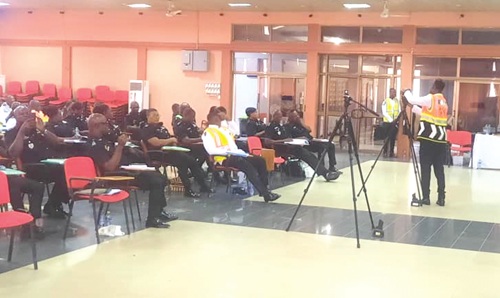
The Ghana Police Service (GPS) says it has completed the major preparations for the nationwide implementation of the Traffitech-GH system, with personnel trained, enforcement equipment deployed and the digital platform tested to support the new system of traffic law enforcement.
The system, which was scheduled to go live tomorrow, has been rescheduled to start on November 1, this year.
“The Ghana Police Service, through the Motor Traffic and Transport Department (MTTD), has rescheduled the full implementation of the automated traffic law enforcement programme, TRAFFITECH-GH, from lst October to lst November, 2026”.
“The rescheduling is to allow for a more extensive public awareness and education on the programme, including its operations, the traffic offences to be detected, the Electronic Notices of Violation (ENV) to be issued to offending motorists,” the police said in a statement yesterday.
Interview
Speaking to the Daily Graphic in Accra last Monday, the Director of Research, Education and Training of the Motor Traffic and Transport Department (MTTD), Chief Superintendent Alexander Kwaku Obeng, said the service had established regional teams and a back-office system to receive, process and validate evidence generated by cameras deployed on the roads.
He said the GPS had tested the reliability of the software and simulated possible challenges, including internet connectivity and system downtime, to ensure the system remained functional when the enforcement regime became operational.
“It is a digital tool we are using. Our personnel have been trained and the reliability of the software has been tried and tested.
We have also simulated downtime because of the digital service.
“When you gather the evidence on the field and there is an internet connectivity problem, the system is able to work offline and upload the information when there is better connectivity,” he said.
TRAFFITECH-GH forms part of efforts by the police to address indiscipline on Ghana's roads and improve compliance with road traffic laws and regulations.
The new system
The system uses cameras and sensors to automatically take a picture and/or video of vehicles that flout road traffic laws and regulations such as speeding and running a red light.
Chief Supt. Obeng said the police had adequate personnel to begin the implementation, with about nine regional teams prepared to support the system.
He said the teams would be responsible for operating the enforcement equipment, generating traffic offence events and supporting the processing and validation of evidence before Electronic Notices of Violation (ENVs) were issued to motorists.
He said the back-office system had also been equipped with reliable power and connected to relevant databases to enable the police to identify vehicle owners and validate information before issuing tickets.
“At the back-office, we have reliable sources of power so that we do not create backlogs.
Our data source has also been tested.
The software is able to talk to our data source and get real-time information.
We have also added transparency to the ticket issuance process,” he said.
He said the new system would initially focus on speeding, with motorists captured exceeding the prescribed speed limits receiving electronic notices on their phones instead of being stopped by police officers and taken through the traditional process at police stations.
Chief Supt. Obeng said the shift was intended to reduce the reliance on manual enforcement and allow the police to deal with traffic offences more efficiently.
“When we capture the speeding offence, the evidence is processed and a formal Electronic Notice of Violation is sent to the vehicle owner’s telephone number. The person will have two weeks to either pay or contest the notice.
“Instead of arresting the person, taking him or her to the police station and processing the matter for court, we are using the digital system to serve the motorist,” he explained.
Cameras
He said the service had deployed two categories of cameras ahead of the November 1 rollout.
One category consists of cameras retrofitted into smart police vehicles, while the other involves tripod-mounted cameras deployed at selected locations.
The mobile cameras, he said, would allow the police to move between different corridors depending on the pattern of speeding recorded on a particular day or during specific periods such as rush hours.
“The speeding behaviour is dependent on the particular day, the rush hour and other circumstances.
So, where the data tells us there is a speeding problem, the mobile cameras will move there.
“The tripod cameras are also deployed at specified locations and the officers can move them when the behaviour changes from one location to another,” he added.
He said the cameras had already been deployed in parts of Accra, Tema, Takoradi, Kumasi, Sunyani, Tamale, Koforidua and Ho, while the mobile enforcement vehicles are expected to cover major intercity corridors.
Chief Supt. Obeng said the nationwide nature of the system was necessary because speeding offences occurred across different parts of the country and police vehicles were already moving through major corridors as part of the testing and caution-notice exercise.
He said the police had travelled several major routes, including Accra-Cape Coast-Takoradi, Takoradi-Yamoransa-Kumasi, Kumasi-Sunyani-Techiman-Tamale and routes linking Accra with Nkawkaw, Koforidua and Aflao.
The MTTD Director of Research, Education and Training said the exercise had helped the GPS gather data on speeding and identify areas requiring targeted enforcement.
Speeding
He said the police was prioritising speeding because of its contribution to road crashes.
“Speeding is among the human behavioural causal factors of road crashes, speeding alone accounts for 62 out of 100 road crash deaths.
Therefore, we want to prioritise speeding and deal with it first, and then add the other behaviours prohibited under the Road Traffic Regulations,” he said.
Further additions
He said the system would later be expanded to cover other traffic violations, including dangerous manoeuvring, unlawful overtaking, tailgating and other forms of road-user behaviour linked to impatience and intolerance.
He said a third category of enforcement equipment was also being prepared and is expected to be deployed later in the year.
Chief Supt. Obeng said the third system would be capable of detecting both speeding and red-light violations, particularly at hazardous and signalised junctions.
He said the police was studying crash data to determine where the equipment should be deployed, citing the Borteyman New Road junction towards the Stadium, the Fiesta Royale area on the N1 George Bush Highway and the signalised junction around Kawukudi on the Kanda Highway as locations under consideration.
He said the system had also been designed with safeguards to prevent motorists from being wrongly penalised and to reduce opportunities for manipulation by officers.
Chief Supt. Obeng said officers operating the cameras would not determine which vehicles the system would capture, while personnel at the back office would independently receive and validate the evidence.
“The event generator has no control over the event capture.
At the back office, we have a robust monitoring system which checks where our men are deployed.
“We receive the events from the devices in the field, process them and obtain information from DVLA and the National Insurance Commission to establish who owns the vehicle.
Beyond that, we validate the evidence before imposing the appropriate fine,” he said.
Vehicle ownership
He urged vehicle owners who had sold their vehicles but had not transferred ownership at the DVLA to regularise their records to avoid receiving tickets for offences committed by new owners.
“The ticket will go to the owner whose name is on the vehicle register.
So, we are admonishing vehicle owners who have sold their vehicles to go to DVLA and change the name on the vehicle register.
Until the new owner is properly onboarded, the system will continue to recognise the person whose name is on the register,” he said.
