
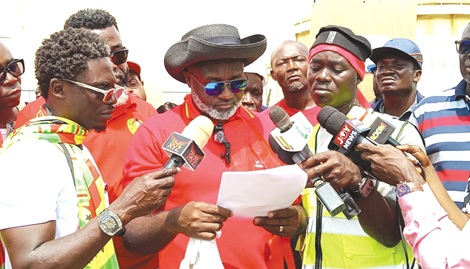
The General Transport, Petroleum and Chemical Workers’ Union (GTPCWU) of the Trades Union Congress (TUC-Ghana) has threatened a nationwide strike if Parliament passes the National Petroleum Authority (NPA) Bill, 2026, in its current form.
The union says provisions seeking to remove the exclusive mandate of the Bulk Oil Storage and Transportation Company Limited (BOSTenergies) to develop, own, operate and maintain inland petroleum depots could undermine the state-owned company’s financial viability, threaten jobs and compromise national energy security.
At a press conference held at the premises of BOSTenergies at Kpone in the Greater Accra Region on Monday, November 23, 2026, the National Chairman of the union, Bernard Owusu, said it was not opposed to private sector participation in the downstream petroleum industry but wanted such involvement to be pursued through partnerships with BOSTenergies under the Public Private Partnership Act, 2020 (Act 1039).
He said Clause 103 of the proposed legislation, which seeks to open inland depot operations to private operators, could weaken the company’s operations and undermine critical national infrastructure.
The union has, therefore, called for the retention of BOSTenergies’ exclusive mandate over inland depots and their interconnecting infrastructure, warning that failure to amend the provision would compel it to mobilise petroleum workers nationwide for industrial action.
Pipelines
Mr Owusu said BOSTenergies operated approximately 350 kilometres of petroleum pipelines linking key facilities, including the Tema thermal power generation area, the Accra Plains, Akosombo and Buipe, with extensions supporting the distribution of petroleum products to the northern parts of the country.
He said the network helped reduce transport and distribution costs, while the margins generated from its operations funded infrastructure maintenance, upgrading and expansion.
The union rejected suggestions that the margins constituted an unfair commercial advantage, arguing that they were necessary to sustain infrastructure serving the national interest.
Mr Owusu also questioned the consistency of the NPA’s regulatory approach, arguing that although the bill sought to reduce the state’s role in inland depot operations, the authority would retain responsibility for administering the Unified Petroleum Pricing Fund (UPPF).
He said the NPA also charged bulk distribution companies an annual licence fee of US$100,000 and a variable fee of US$5 per metric tonne of petroleum products supplied to the market.
The union said BOSTenergies increased its permanent workforce from 440 in 2024 to 743 by November 2025, creating 303 additional permanent unionised jobs in support of the government’s 24-hour economy programme.
It warned that diverting petroleum volumes to private depots could leave national infrastructure underutilised, threaten jobs and increase the company’s dependence on government support.
It further cautioned that reduced throughput could increase the company’s distribution margin from 12 pesewas to about 56 pesewas per litre, potentially raising petroleum supply costs.
Petition
Mr Owusu said the union had petitioned President John Dramani Mahama, the Minister of Energy and Green Transition and Parliament to amend the bill, publish the final stakeholder engagement report and conduct an assessment of its impact on BOSTenergies’ financial viability.
It also called for the company to be allowed to sell petroleum products directly to oil marketing companies and for restrictions limiting its import cargo windows to two per month to be removed.
The union said it had engaged the relevant authorities since August 2026, submitted proposals and participated in stakeholder consultations but was concerned that the bill had been resubmitted to Parliament without incorporating its recommendations.
It urged Parliament to reconsider the proposed legislation, warning that failure to address its concerns would trigger nationwide industrial action across the petroleum value chain.
Writer’s email:
