
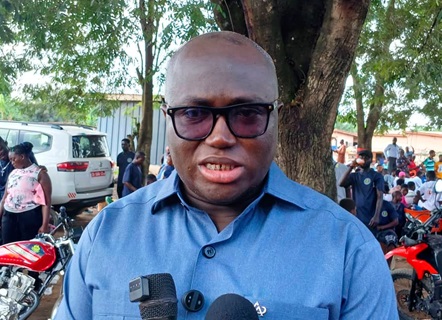
Suhum and Abuakwa South Municipalities, both in the Eastern Region, host numerous farming communities.
Apart from the Suhum and Kyebi townships, the capitals of the two municipalities, most residents in the other communities derive their livelihoods from trading and farming.
Communities surrounding the two towns such as Jato, Nankese, Okorase, Akorabo, Obretema, Omenaku, Ayisikrom and Kofigya in the Suhum Municipality and Apapam, Afiasa, Ahwenease, Adadietam, Akwadum, Potroase, Apedwa and Akyem Asafo in the Abuakwa South Municipality are purely rural and agrarian with most of the dwellers being farmers.
The current population of Suhum township is estimated at 36,268, while Kyebi township has a population of about 73,949.
Lack of parental care
However, due to a lack of parental care, many school-age children are often seen trading or engaged in hazardous farming activities, primarily on cocoa plantations or in illegal mining (galamsey).
Others are also trafficked to other parts of the country or abroad for all sorts of activities detrimental to their health and wellbeing.
Eventually, many become social misfits and a danger to society.
Vulnerable groups
Children constitute one of the most vulnerable groups in society and continue to face multiple forms of rights violations, including child trafficking, child labour, neglect, violence, exploitation, inadequate access to quality education and health services and weak child protection systems.
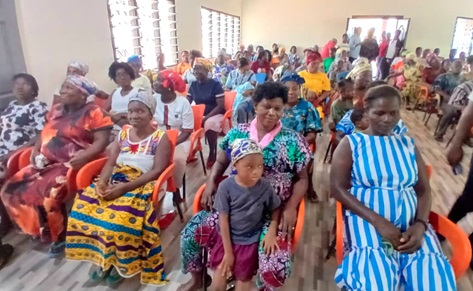
Women at Jato community were also educated on the effects of child labour
Although Ghana has made significant commitments under the Constitution—the United Nations Convention on the Rights of the Child (UNCRC), the African Charter on the Rights and Welfare of the Child and the Children’s Act, 1998 (Act 560) —implementation gaps remain, particularly at the local government level.
The Eastern Region,however, continues to experience vulnerabilities associated with internal migration, child labour, informal economic activities, poverty, weak family support systems and increasing exposure of children to online exploitation.
While institutions including the Department of Social Welfare and Community Development, Commission on Human Rights and Administrative Justice (CHRAJ), the Ghana Police Service, municipal and district assemblies, schools, traditional authorities and Civil Society Organisations (CSOs) are mandated to protect children, challenges relating to coordination, resources, referral pathways and enforcement continue to undermine effective service delivery.
Recent national administrative data further demonstrates the urgency of the problem.
Child trafficking data
Reported human trafficking victims increased significantly from 794 cases in 2024 to 2,331 cases in 2025, with children accounting for a substantial proportion of victims.
Labour trafficking remains the dominant form of exploitation, while online recruitment and fraudulent schemes such as QNET in related trafficking have emerged as new pathways through which children and young people are trafficked.
In view of the issues of child trafficking, child labour, child marriages and all forms of child abuse has therefore compelled members of the Parliamentary Committee on Human Rights in collaboration with the Inter-Parliamentary Union, Office of the United Nations High Commissioner for Human Rights (OHCHR), UNICEF Ghana and the African Centre for Parliamentary Affairs (ACEPA) together visited some towns and communities in the region including namely Suhum Jato, Nankese, Okorase, Akorabo and Omenaku in the Suhum Municipality and Kyebi, Apapam, Afiasa, Akwadum and Apedwa in the Abuakwa South Municipality among others.
First-hand evidence
The visit allowed MPs to assess the situation firsthand, gather evidence on child rights challenges, strengthen collaboration among child protection actors, and inform parliamentary insights, legislation, and budget advocacy aimed at improving outcomes for children.
The programme is a partnership to enable Parliament and other partners to better understand challenges in towns and communities and identify practical measures to strengthen child protection and social protection.
Challenges
Addressing stakeholders, chiefs and people in the beneficiary towns and communities, the Parliamentary Committee on Human Rights attributed the myriad of challenges confronting children in communities in the Eastern Region to parental neglect.
Some of the challenges, the committee stated, were child trafficking, child labour, child marriages and substance abuse, among other child-related issues in the region.
The Chairman of the committee, Ernest Yaw Anim, MP for Kumawu in the Ashanti Region, who led the team, said it was unfortunate that many of the children were suffering due to parental neglect.
He said it was worrying that state institutions mandated to ensure children's welfare had also failed to do so, as the issues still lingered in towns and communities.
Unknown places
Mr Anim said the core of the issue was parental neglect saying that had led to many of the children going wayward or suffering.
"Children spend a greater number of hours with their parents at home as compared to school, so parents bear absolute responsibility for guiding the children.
Parental neglect is affecting the well-being and upkeep of Ghanaian children; state institutions that are supposed to provide the necessities for the children have also failed in that direction", Mr Anim stated.
"We owe the children more than policies and programmes; we owe them protection, dignity, opportunity and hope.
We are here not to pass judgement but to listen, understand the realities on the ground, identify gaps and work together towards practical solutions", Mr Anim told the gathering.
Support
The Chief Social Policy of the United Nations Children's Fund Ghana, Pauliina Sarvilahti, said the visit was to support Parliament's broader commitment to ensuring that public institutions uphold the rights guaranteed to every child under national legislation and international human rights instruments.
She said Ghana was, therefore, committed to continuing to improve children's rights through strong legal and policy frameworks to actively protect the rights of such unfortunate children in towns and communities across the country.
Ama Theresah Ansah from Kyebi town told the Daily Graphic that their children were exposed to all forms of child related abuses such as child labour, child trafficking because of illegal mining (galamsey) activities in the area.
She said because such communities were deprived many people visits such communities to do illegal mining there by succeeding in trafficking children to other neighbouring towns or outside the country.
She therefore called on the Parliamentary Committee on Human Rights and other partners to help address the issues regarding child labour and child trafficking in the town.
Writer's email
