
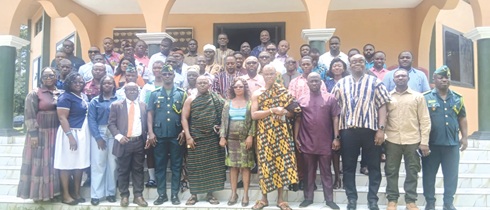
The National Security Council Secretariat (NSCS) has engaged stakeholders in the Western North Region as part of consultations towards reviewing Ghana’s 2020 National Security Strategy (NSS).
The engagement, held at Sefwi Wiawso, the regional capital, sought to solicit practical views and evidence-based inputs on security threats, risks and challenges peculiar to the region, particularly those relating to border security, to inform the development of a responsive and inclusive national security strategy.
According to Technical/Intelligence Aide to the National Security Coordinator at the NSCS, Dr Bako Mohammed, national security strategies are not static documents but require periodic reviews to remain relevant and responsive to changing domestic, regional and global security environments.
Ghana launched its maiden National Security Strategy in 2020 to provide a coherent framework for addressing security threats to the state and its citizens.
The NSCS said the current review was both a policy necessity and a statutory requirement under the Security and Intelligence Agencies Act, 2026 (Act 1168), which repealed the Security and Intelligence Agencies Act, 2020 (Act 1030), and shortened the prescribed review period to one year.
Consultation
Addressing the gathering forum last Monday, Dr Mohammed said the engagement was intended to gather regional perspectives on security threats, risks, vulnerabilities and emerging concerns confronting the country.
He noted that several domestic security challenges had intensified since the introduction of the previous strategy.
He cited illegal small-scale mining, popularly known as galamsey, as a major concern, explaining that its effects extended beyond environmental degradation and economic losses to include conflict, weakened state authority in affected communities and links to organised criminal networks.
He further identified violent extremism, terrorism, transnational organised crime, illicit arms trafficking, narcotics-related activities, conflicts, cybercrime, misinformation, disinformation and climate-related security challenges as emerging threats requiring sustained attention.
Dr Mohammed said the consultation formed part of broader stakeholder engagements being undertaken by the NSCS to gather regional perspectives for consideration in the review of the 2020 National Security Strategy.
He encouraged participants to prioritise early warning systems and preventive interventions, stressing that the timely identification and reporting of potential threats could help prevent local disputes and other security concerns from escalating into major crises.
Security concerns
The Deputy Planning Officer, Abdul-Razak Monyun, who represented the Western North Regional Minister, Wilbert Pretty Brentum, commended the NSCS for organising the regional stakeholder engagement, saying it provided an opportunity for participants to deliberate on key threats, risks and security concerns confronting residents and to offer regional perspectives towards developing a revised and forward-looking national security strategy.
He emphasised that protecting communities and national borders required collective responsibility and resilience in responding to emerging threats.
The engagement brought together representatives of security agencies, traditional authorities, local government institutions, the clergy, the media and other relevant stakeholders to deliberate on security concerns and priorities in the Western North Region.
