
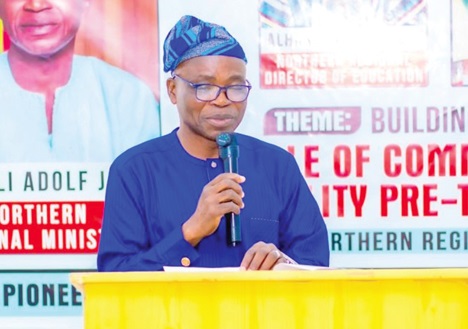
The Northern Regional Minister, Ali Adolf John, has directed the Northern Regional Directorate of the Ghana Education Service (GES) to investigate reports of irregularities in the implementation of the Ghana School Feeding Programme in the region.
He said he had received reports that some caterers were serving meals for only two or three days a week, instead of the contracted five days, while some schools were recording inflated beneficiary figures, with pupil numbers exceeding those captured in their official registers.
He said such irregularities, if left unchecked, could undermine efforts to extend the programme to other deprived schools and deny vulnerable children the nutritional support intended for them.
Mr John gave the directive at a Regional Education Forum held in Tamale, on the theme: "Building Strong Partnerships: The Role of Communities in Advancing Quality Pre-Tertiary Education”.
Organised by ActionAid Ghana in collaboration with the Northern Regional Coordinating Council(NRCC), the forum brought together officials of GES, Metropolitan, Municipal and District Assemblies(MMDAs), traditional leaders, civil society organisations, Parent-Teacher Associations and School Management Committees, among others, to examine the state of education in the region and discuss ways of improving learning outcomes, retention, inclusion and accountability.
Coordination
In his remarks, Mr John said the region continued to face challenges, including inadequate infrastructure and learning resources, teacher and pupil absenteeism, teenage pregnancy, among others, and stated that addressing such challenges required sustained collaboration among district authorities, education managers, schools, parents and communities.
He, therefore, urged MMDAs, GES and civil society organisations to strengthen coordination and integrate education priorities into district development plans to enhance educational outcomes in the region.
While stressing the need for community participation in decision-making on educational issues, he lauded ActionAid Ghana for continuously championing development issues, particularly in education and human rights.
Violence
In his presentation, the Northern Regional Statistics Officer of the GES, Alhassan Seibu, indicated that 65 cases of violence were recorded in 15 Senior High Schools (SHSs) across the region in 2025.
He stated that physical assault on students topped the list with 37 cases, while sexual harassment by colleagues followed with 12 cases.
Also, extortion by colleagues and cyberbullying recorded five cases each, while damage to property and assault on staff by students recorded two cases each.
To address the situation, Mr Seibu said the directorate had put in place stringent measures to tackle indiscipline in schools, including strengthening guidance and counselling services, enforcing the code of conduct for both students and staff, and intensifying collaboration with parents, School Management Committees and security agencies to promptly resolve reported cases.
He added that it had also intensified sensitisation of students and staff on acceptable behaviour, while ensuring that reported cases were thoroughly investigated and appropriate sanctions applied to serve as a deterrent.
Accountability
The Head of Programmes, Campaigns and Innovations at ActionAid Ghana, Justin Bayor, stressed the need for stronger accountability in the delivery of education services.
He said effective monitoring and accountability mechanisms were crucial in ensuring that resources meant to support children were used for their intended purposes and that education services met the needs of learners.
He added that quality education could not be measured only by the number of children entering classrooms, but also by whether they were learning and receiving the support they needed.
