
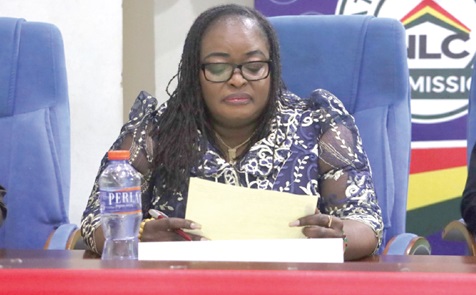
Unfair termination and dismissal have emerged as the leading cause of labour disputes in Ghana, with the National Labour Commission (NLC) handling 13,113 complaints over the past 20 years, the Executive Secretary of the NLC, Dr Bernice A. Welbeck, disclosed.
She said disputes arising from the severance of employment relationships, including dismissals, terminations and redundancy, accounted for 58 per cent of all complaints handled by the commission between April 2005 and December 2025.
She attributed the trend to poor employment contracts, failure by employers to observe due process, weak human resource management practices and inadequate understanding of the country's labour laws.
Dr Welbeck disclosed this when she presented the commission's 20-year report at a public symposium organised by the NLC in Accra yesterday to commemorate two decades of its establishment.
The symposium was on the theme: "Two decades of the work of the National Labour Commission: Lessons, experiences, challenges and the way forward."
She said of the 13,113 complaints handled during the period, 12,677 had been fully resolved, while 317 were undergoing facilitation and 119 remained unprocessed because of the failure of the parties to respond.
"The records show that severing the employment relationship, whether through termination, dismissal or redundancy, recorded the highest number of disputes during the reporting period, representing 58 per cent," Dr Welbeck stated.
Poor HR practices
Dr Welbeck said many of the disputes could have been avoided if employers complied with established procedures and strengthened their human resource management systems.
She cited poorly drafted employment contracts, failure to follow disciplinary procedures before terminating workers, poor leave management, inadequate supervision and misuse of casual employment arrangements as recurring causes of disputes.
She explained that some employers continued to retain workers on casual contracts for several years in contravention of the law, while others relied solely on notice to terminate employment, notwithstanding the existence of established disciplinary procedures.
The Executive Secretary also identified denial of maternity leave, accumulation of annual leave, unpaid salaries and overtime, redundancy disputes and union-related disagreements among the major issues brought before the commission.
Dr Welbeck said the commission had maintained a high settlement rate through facilitation, mediation, arbitration and adjudication.
She added that the commission had also secured compensation running into hundreds of thousands of cedis annually for workers whose dismissals or terminations were found to be unlawful.
Future of work
The Chief Director of the Ministry of Labour, Jobs and Employment, Hamidu Adakurugu, said the changing nature of work required the commission to reposition itself to address emerging labour market challenges.
He said artificial intelligence, digital platforms, climate change and the African Continental Free Trade Area (AfCFTA) would fundamentally reshape employment relationships, making it imperative for the commission to strengthen its technical and research capacity.
Mr Adakurugu said the commission must become "more technically capable, research-driven, regionally accessible and more internationally connected" to remain effective in promoting industrial harmony.
Commission reconstitution
The immediate past Chairperson of the NLC, Justice Kwabena Asamani-Adu (retd), appealed for the urgent reconstitution of the commission following the expiration of the tenure of its fifth governing body on July 7, 2026.
He said the absence of a substantive commission could affect the institution's ability to perform its statutory functions and urged the tripartite partners to expedite the appointment of new commissioners.
Justice Asamani-Adu also advocated amendments to the Labour Act to allow for a blend of permanent and part-time commissioners to improve efficiency, citing the increasing workload placed on members.
