
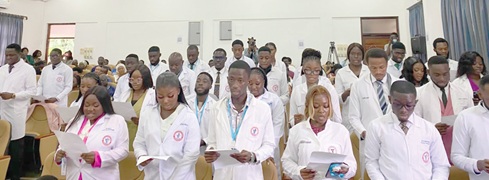
The Veterinary Council of Ghana (VCG) has inducted 65 newly trained veterinary surgeons into the profession, with a call on them to uphold professional integrity and contribute to animal health, food safety and public health.
The inductees, who completed the six-year Doctor of Veterinary Medicine programme at the University of Ghana (UG) and the Kwame Nkrumah University of Science and Technology (KNUST), took their professional oath at a ceremony in Accra last Friday.
The ceremony was held on the theme, “Upholding Professional Excellence for a Healthier Ghana: Our Commitment to Animal Health, Food Safety and One Health”.
Professional integrity
A member of the Veterinary Council of Ghana, Professor Richard Susu-Ire, urged the new veterinary surgeons to uphold professional integrity and ethical standards.
He advised them to base their decisions on sound judgement and resist financial pressures, personal interests and convenience that could compromise their duties.
Professor Susu-Ire stressed that honesty in decision-making and accurate record-keeping were essential to maintaining professional standards and building public trust.
Livestock production
The Director of Presidential Initiatives in Agriculture and Agribusiness at the Office of the President, Dr Peter Boamah Otokunor, who delivered the keynote address, described veterinary services as critical to expanding local livestock and poultry production.
He explained that sustainable growth in commercial poultry production required effective disease surveillance, vaccination, biosecurity and veterinary support.
“We cannot expand commercial poultry production sustainably if the farmers continue to face preventable disease outbreaks and significant production losses,” he said.
Improved animal health, he added, would enable farmers to protect their investments, increase productivity and reduce the country’s dependence on imported animal products.
Dr Otokunor also highlighted the One Health approach, which recognises the links between human, animal and environmental health.
“What begins as an animal health problem can quickly become a public health concern, with serious implications for livelihoods, food production and national economies,” he stressed.
Employment opportunities
Dr Otokunor identified livestock production, aquaculture, food processing and disease surveillance as areas offering employment opportunities for the newly qualified professionals.
He said the government’s agricultural transformation agenda would create opportunities for veterinary surgeons to contribute to the development of the livestock industry.
“That means that there would be jobs for all inductees that are passing out today,” he assured them.
He encouraged the new professionals to explore careers in research, biotechnology, public policy and veterinary entrepreneurship, beyond traditional clinical practice.
“As agriculture production becomes more intensive and commercially oriented, the demand for specialised veterinary knowledge and services would only increase,” he explained.
He also urged them to serve rural communities where access to veterinary services remained limited.
