

The inauguration of a new six-unit classroom block and renovated teachers’ quarters at Dwirigum D/A Primary School in the Wassa Amenfi Central District in the Western Region has renewed attention on infrastructure and basic service gaps affecting education in rural communities.
Although the facilities are expected to improve teaching and learning, the absence of electricity in the community has raised concerns about the effective utilisation of some of the infrastructure, particularly the newly established Information and Communication Technology (ICT) laboratory.
The facilities were inaugurated by the District Chief Executive (DCE), Mr Peter Amponsah, at a ceremony at Dwirigum in the Wassa Amenfi Central District in the Western Region.
The classroom block, comprising an office, storeroom, ICT laboratory, urinal bay and toilet facilities, was funded by the Embassy of Japan in Ghana under its Grant Assistance for Grassroots Human Security Projects (GGHSP).
In a separate intervention, Lotte Co. Ltd. renovated and expanded the school's original one-bedroom teachers’ accommodation into a four-bedroom facility, with each bedroom having its own kitchen, toilet and bathroom.
The projects address two important aspects of rural education: the provision of a conducive learning environment and improved accommodation for teachers.
Addressing the gathering, Mr Amponsah said the old classroom block was in a deplorable condition, with deteriorating walls, a leaking roof and inadequate furniture creating challenges for effective teaching and learning.
He said the Assembly had submitted a proposal to the Embassy of Japan, which subsequently provided a grant of US$72,593, equivalent to GH¢1,126,669, towards the construction of the new classroom block.
He said Lotte Co. Ltd. had also supported the rehabilitation and furnishing of the teachers’ accommodation to improve their welfare.
As part of the intervention, the Assembly provided a mechanised borehole with an overhead poly tank, eight desktop computers with uninterruptible power supply (UPS) units, 120 dual desks, 12 teachers’ tables and chairs as well as conference furniture.
These facilities are expected to address some of the school's basic needs, while the computers offer pupils an opportunity to acquire digital skills essential for modern education.
Mr Amponsah also urged residents to take ownership of the facilities, assuring the District Education Directorate of the Assembly's continued collaboration to ensure that the school had the required number of teachers. He said proper maintenance could attract further development projects to the community.
Lack of electricity
However, the absence of electricity threatens to limit the benefits of the ICT laboratory.
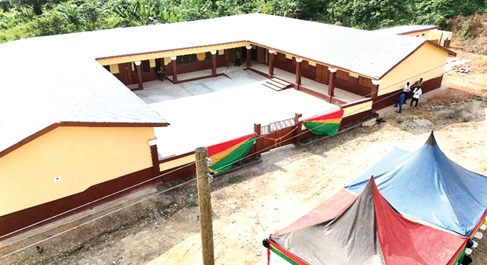
Aerial view of the classroom block comprising an office, storeroom, ICT laboratory, urinal bay and toilet facilities
Speaking on behalf of the traditional authorities, the Tufuhene of the Wassa Amuni Divisional Area, Nana Kwaku Akannor, appealed to the government to complete an abandoned rural electrification project initiated in 2015.
He said electricity poles and cables had been installed but the community remained without power.
He questioned how the newly established ICT laboratory could function effectively without a reliable electricity supply.
The concern highlights a broader challenge confronting rural education: infrastructure investments must be supported by essential services to deliver their intended benefits.
Although the computers have UPS units, these cannot replace a dependable electricity supply. Without power, pupils could be denied the opportunity to use the equipment and develop practical computer skills.
At a time when digital literacy is increasingly important, the situation could widen the gap between pupils in rural and urban schools.
Completing the electrification project would not only benefit the school but also improve living conditions and support economic activities in the community.
Another important aspect of the intervention is the improvement in teachers’ accommodation. Inadequate housing and poor living conditions can make rural postings unattractive, affecting efforts to attract and retain qualified teachers.
The General Manager of Lotte Co. Ltd., Kubo Naoki, described the intervention as an investment in the future of the children and the next generation.
He said education remained the foundation of national development and stressed that teachers played a critical role in identifying children's potential and guiding them towards success.
He expressed the hope that the improved accommodation would provide teachers with the comfort needed to discharge their professional responsibilities effectively.
The Wassa Amenfi Central District Director of Education, Ann Konadu, described the inauguration as an investment in hope and opportunity for the children.
She expressed appreciation to the Government of Japan, Lotte Co. Ltd. and the District Assembly for their commitment to improving educational infrastructure in the district.
She, however, called on traditional authorities, parents, teachers and community members to take collective responsibility for maintaining the facilities.
She also appealed to corporate institutions, development partners and non-governmental organisations to support educational development in the district.
Development
The Japanese Ambassador to Ghana, Hiroshi Yoshimoto, said the project demonstrated Japan's commitment to grassroots development and improving educational infrastructure.
He said the Government of Japan had provided funds towards the construction of the classroom block and toilet facilities, while Lotte Co. Ltd. had separately supported the renovation of the teachers’ quarters.
“Children need a safe place to learn.
Teachers also need a good place to work.
I hope these new facilities will make school life better for everyone,” he said.
He commended Lotte Co. Ltd. and ITOCHU Corporation for their contributions and urged the community to protect and maintain the facilities to ensure their sustainability.
The Dwirigum intervention represents an important investment in rural education.
However, its long-term impact will depend on addressing the electricity challenge, ensuring adequate teacher availability and maintaining the facilities.
Completing the abandoned electrification project will be particularly critical to making the ICT laboratory functional and ensuring that pupils benefit fully from the investment.
