
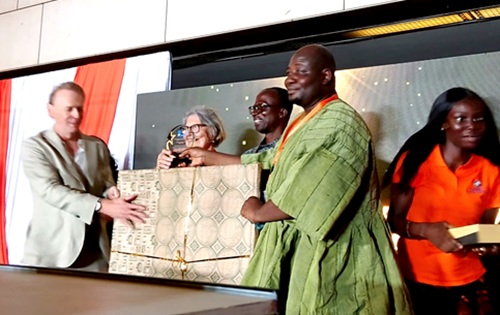
The Netherlands Embassy in Ghana has awarded its Entrepreneur of the Year Award to African Tiger Holding, a business group whose subsidiaries span agriculture, hospitality and real estate.
Kuipers Breeders-Gh, a leading provider of high-quality day-old chicks and Safisana Ltd, a company that transforms faecal and organic waste into renewable energy and organic fertiliser, were also named as the second and third winners at the ceremony, held in Accra to mark the Day of the Entrepreneur, which is observed on the third Friday of November by businesses in the Netherlands.
The awards, organised by the embassy together with the Ghana-Netherlands Business Cooperation (GBNCC), seek to recognise companies with a link to the Netherlands. This could be Ghanaian companies who are exporting to the Netherlands or companies from the Netherlands who are active in Ghana, doing business in different sectors of the economy, including transportation, horticulture, agriculture, health care, logistics and technology.
It is also an occasion to recognise companies who have invested in Ghana, built operations and deliver results in different sectors — in jobs, innovations, sustainable practices and in commercial success.
Describing the winners as illustrating the diversity and potential of the Ghana-Netherlands economic relationship, the Netherlands Ambassador to Ghana, Hans Akerboom, said this year’s award, the third since it was started, received entries from over 70 companies, out of which the three emerged as winners.
He disclosed that the Netherlands and Ghana had a long-standing trading relationship, pointing out that many Dutch companies were active in key sectors of Ghana’s economy, including agriculture, horticulture and technology, while at the same time Ghanaian companies were looking beyond their borders to African and European markets.
Export
He said the embassy wanted to see more companies from the Netherlands not only exporting to Ghana’s market but also investing here, creating jobs, working together and developing activities that created value within Ghana.
“And, of course, vice versa.
We want to see more businesses from Ghana exploring opportunities in the Netherlands and using the Netherlands as a gateway to wider European markets.
Ghanaian companies bring local knowledge, networks and innovation. Dutch companies bring experience and expertise.
We should connect the right businesses and create more possibilities into concrete, long-term partnerships. This is where the embassy and the GNBCC aim to play a very practical role,” he said.
The Deputy Chief Executive Officer (CEO) of the Ghana Investment Promotion Authority (GIPA), Abdul Razak Baba, said the authority recognised that while Ghana offered tremendous opportunities, the experience of doing business here did not always match that potential, citing as examples the regulatory requirements businesses had to navigate through and the permits and licences they had to deal with.
He said to create the operating environment conducive for businesses to thrive in Ghana, they had passed more than 12 pro-business laws, and the biggest was the Act that had been passed to change the name from a centre to an authority.
Act
Mr Baba mentioned some of the major reforms of the new laws to include the scrapping of the minimum capital requirement to do business in Ghana; the creation of a one-stop shop at GIPA to obtain all the permits needed to do business in Ghana; the offer of citizenship based on the amount of investments, number of times and number of years the business had been in Ghana; and the provision of an investor grievance mechanism.
The GIPA Deputy CEO said they have so far had 1500 engagements, recorded about 95 issues and had been able to resolve about 55 per cent of those issues.
“Our target is to go all the way to about 90 per cent resolution rate, but we're starting with 55. So these are the pro-business investments and laws that we have put together to ensure that we make the business environment conducive for you,” he said.
In his winning remarks, the CEO of Africa Tiger Holdings, Imoro Sulemana, said they had Royal Senchi, Zena Lodge, a football academy, Wafa Football Academy and Palm plantations under the holding, adding that the company had about 6000 workforce across all their businesses.
He said going forward, they wanted to deepen their engagement in vegetable production.
