
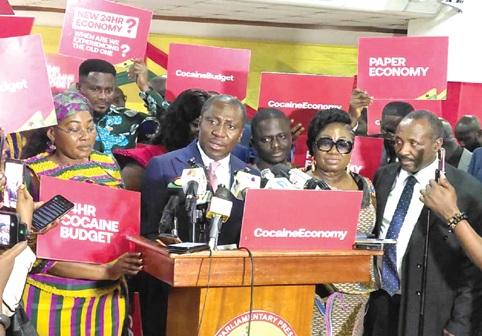
The Minority Leader, Alexander Afenyo-Markin, has described the 2027 Budget Statement as promising a “paper economy” because it fails to reflect the economic realities confronting Ghanaians.
He said that as the Finance Minister touts growth and a reduction in inflation, those numbers remained on paper, as they did not translate into lowering the cost of living in the economy.
Mr Afenyo-Markin cited rising food prices in local markets, high unemployment and the difficulties in running businesses.
Addressing a press conference in Parliament yesterday, immediately after the presentation of the budget by the Minister of Finance, Dr Cassiel Ato Forson, the Minority Leader said the budget was “stability on paper but hardship in our pockets”.
“The NDC cannot rebrand unemployment and they cannot slogan away the cost of living,” he said.
We won’t be silenced
With Minority Caucus members carrying placards, some of which read “Scam economy”, “Cocaine economy”, after the presentation, Mr Afenyo-Markin said the Minority would not be silenced in its scrutiny of the budget, despite what he described as attempts by the Speaker of Parliament to prevent the caucus from making preliminary observations on the statement on the floor of the House.
“We cannot be silenced when the Finance Minister came to present to us a paper economy, when the figures do not reflect the reality on the ground,” he stated.
Mr Afenyo-Markin cited what he called prevailing high food prices at markets across the country, including Kotokoraba, Koforidua, Sejiman, Tamale, Kumasi Asafo and Winneba Central markets, as evidence that the economic conditions facing ordinary Ghanaians remained difficult.
“The reality is that at the Kotokoraba market, at the Koforidua market, Tamale Aboabo market, Kumasi Asafo market, and at the Winneba Central market, prices of foodstuffs remain high and Ghanaians cannot afford them,” he said.
The Minority Leader also questioned the government's commitment to agricultural development, arguing that the proposed processing of maize and other farm produce was not supported by adequate interventions to help farmers increase production and reduce food prices.
He said despite the government's promises, the prices of rice, maize, sorghum and yam had continued to rise over the past two years.
“Meanwhile, for two years, we've seen the rising cost of rice, maize, sorghum and yam.
These are produce from our farmers, and they are more expensive than imported rice, maize and sorghum,” he said.
He added that farmers were struggling because they were not receiving the necessary government support.
“He himself was a Minority Leader. He said that the way the economy was being run was not the right way and that the John Mahama-led government would do better.
Today, when Ghanaians call upon the government to provide jobs, Dr Ato Forson is saying that the work ahead demands patience,” he said.
Mr Afenyo-Markin further questioned the government's proposed four-year development plan, which he said appeared to extend beyond the administration's current mandate.
He said although the government had announced a new development plan running from 2027 to 2030, it had failed to explain how the programme would be implemented and financed within the period remaining in its tenure.
He particularly questioned the allocation and expenditure of the proposed $10 billion for the new economy.
“They did not tell us how much of the $10 billion earmarked for the new economy will be available for the year 2027,” he said.
“They also failed to tell us how much will be expended in 2027 and the specific projects this will finance for proper tracking.”
He also questioned the relationship between the proposed new economy and the government's flagship 24-hour Economy policy.
“What is the difference between the New Economy and their so-called 24-hour Economy? In fact, our question is, how many economies will the NDC build in Ghana within four years?” he asked.
The Minority Leader also raised concerns about the reduction in the funding commitment for the government's Big Push infrastructure programme, saying the amount had been reduced from the initially announced $30 billion to $14 billion.
He said the government needed to explain the reduction and demonstrate how the revised allocation would support the implementation of major infrastructure projects.
On employment, he accused the government of failing to provide convincing figures on the number of jobs created since assuming office.
He said the government's economic presentation placed too much emphasis on data and projections without adequately addressing the urgent demand for jobs.
“According to PricewaterhouseCoopers, the best thing to do is to spend.
The Finance Minister does not spend.
So he wants to keep a flowery data,” he said.
“It is not data that Ghanaians are going to consume.
Ghanaians want jobs, jobs, jobs.
We are not interested in data.
We are not interested in a paper economy,” he added.
