
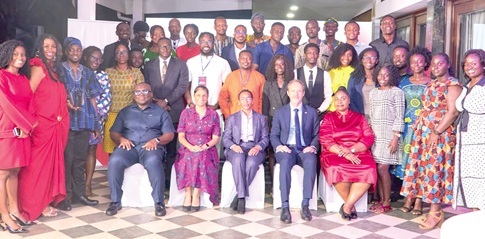
The Minister of Environment, Science and Technology, Dr Zanetor Agyeman-Rawlings, has called for stronger collaboration between journalists and researchers to improve public understanding of science, build trust in scientific findings and translate research into practical solutions for national development.
She said sustained partnership would help bridge the gap between research, innovation, industry and society, and also encourage private-sector investment in homegrown technologies.
“Scientists must be willing to explain their words in simple language, and journalists must ask questions and verify information,” the minister added.
She said scientific progress would not achieve its full potential if the people it was intended to benefit did not understand or appreciate its relevance.
Knowledge-exchange programme
Dr Agyeman-Rawlings was speaking at the close of a 2026 Media Excellence in Emerging Technologies (MEET) Fellowship event in Accra last Friday.
The fellowship was organised by Imperial College London through Imperial Global Ghana, the British High Commission in Accra and Nigeria, with support from the UK Foreign, Commonwealth and Development Office (FCDO).
Ten out of the 29 fellows were selected for a knowledge-exchange programme at Imperial College London later this year to deepen their understanding of emerging technologies to strengthen science reporting.
The selected fellows are Efia Akese of the Graphic Communications Group Ltd; Nana Boakye Dankwah Yiadom of the Multimedia Group; Ibrahim Abode of Metro TV; Nabil Ahmed Rufai, a freelancer; Esther Agyapong, a content creator; Jacqueline Yeboah of the Multimedia Group; Anthony Adongo Apubeo of the Ghana News Agency (GNA); Esther Nkrumah of the Multimedia Group; Ibrahim Khalilulahi Usman of Eco Media Africa; and Portia Cudjoe of Media General.
Emerging technologies
The minister urged journalists to lead sustained public discussions on the implications of emerging technologies, and also called for safeguards to ensure appropriate human oversight and greater transparency in the use of AI-generated content.
She further urged journalists to improve public awareness of the country’s planned January 2026 ban on Styrofoam and also investigate safe disposal and recycling options ahead of its implementation.
Dr Agyeman-Rawlings commended the organisers for supporting the fellowship and reaffirmed the ministry’s commitment to strengthening the country’s science, technology and innovation ecosystem.
Fellowship programme
The British High Commissioner to Ghana, Dr Christian Rogg, said the MEET Fellowship programme was now in its fourth year, and had trained more than 70 fellows over the previous three years, with alumni producing reports on issues, including health, climate change and plastic pollution.
He cited a report on biodegradable plastics developed in the UK, which attracted interest from policymakers in Ghana and other West African countries, as well as an investigation into microplastics and their effects on human health and the environment.
Dr Rogg said the fellowship, implemented through Imperial Global Ghana, had grown from the UK-Ghana Science, Technology and Innovation partnership and helped in building networks linking journalists, researchers and experts across Ghana and West Africa.
The Vice-Chancellor of the University of Media, Arts and Communication (UNIMAC), Professor Eric Opoku Mensah, urged science journalists to give greater visibility to African research and ensure that scientific developments were reported in ways that reflected their practical implications for communities.
He expressed UNIMAC's commitment to continue training media and communication professionals, with the knowledge, confidence and critical thinking skills needed to report responsibly on emerging scientific and technological developments.
In a speech read on his behalf by the Vice-President of the Ghana Journalists Association (GJA), Rebecca Ekpe, the President of the Association, Albert Kwabena Dwumfour, thanked Imperial Global Ghana for their work and said the programme’s impact would depend on how participants applied their knowledge in newsrooms and communities to improve reporting and public discourse.
He said the GJA remained committed to professionalism, press freedom, media development and journalists’ welfare, while urging fellows to maintain the relationships established during the programme.
