
The Minerals Income Investment Fund (MIIF) is on course to exceed its year-end target of mobilising approximately GH¢9 billion in mineral royalties, as it records GH¢7.82 billion in receipts as of the end of last month.
Between January and September 2026, MIIF recorded GH¢7.82 billion in mineral royalty receipts, a 106 per cent increase over the GH¢3.79 billion recorded during the corresponding period last year, thanks to a new sliding scale formula for royalty determination that guarantees the state its due revenue, among other factors.
The strong performance, driven by higher gold prices, is a positive response to the innovative sliding-scale royalty mechanism, resilient production levels and enhanced monitoring of mining activities by the Fund’s Technical and Operations Department.
MIIF is targeting approximately GH¢9 billion in mineral royalty receipts by the end of 2026.
The sliding-scale framework links the applicable royalty rates to the prevailing market price of a mineral.
This means, as mineral prices rise or fall, the royalty rate adjusts accordingly.
It is a shift from the previous royalty regime, where non-small-scale gold mining companies paid a five per cent flat rate, irrespective of price movements.
The new regulation seeks to provide the resource owner (the State) a fair share of the economic value generated during periods of high prices.
The regulation also applies to critical minerals such as lithium.
Contributors
Large-scale gold mining remained the leading contributor, generating approximately GH¢7.66 billion in royalties during the first nine months of 2026, compared with GH¢3.54 billion over the same period in 2025, MIIF data indicate.
The outturn represents an increase of about 116 per cent, accounting for the overwhelming majority of total mineral royalty receipts.
“Mid-tier” gold mining also recorded significant growth, with royalty receipts rising from approximately GH¢55.31 million in the first nine months of last year to GH¢110.34 million during the corresponding period this year, an increase of about 99 per cent.
Among non-gold minerals, quarry royalties increased to GH¢11.35 million from approximately GH¢10.8 million in the first nine months of 2025, representing a growth of about six per cent in 2026.
Sand royalties also increased by almost 41 per cent, from GH¢390,274 to GH¢550,871 during the period under review.
Limestone royalties, however, declined from GH¢7.08 million to GH¢4.84 million, a dip attributable to reduced production, particularly during the second quarter, when increased rainfall disrupted mining activities and constrained output.
The third-quarter results build on MIIF’s strong performance in the first half of the year, when the Fund recorded more than GH¢5.3 billion in mineral royalty receipts, compared with approximately GH¢2 billion during the corresponding period in 2025.
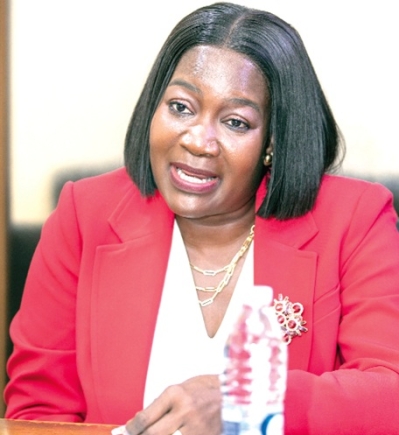
The Chief Executive Officer (CEO) of MIIF, Justina Nelson, reaffirmed the Fund’s commitment to responsible financial management and the effective utilisation of mineral revenues for the benefit of the Republic of Ghana.
She emphasised that MIIF’s mandate extended beyond mineral royalty receipts to include strategic investments across the mining value chain through equities, fixed-income securities and alternative investments, to generate sustainable returns for the State.
As it works towards its annual target of approximately GH¢9 billion, Mrs Nelson said MIIF remained committed to maximising the value of Ghana’s mineral wealth and ensuring that mineral revenues contributed meaningfully to sustainable national development.
“The Fund continues to discharge its statutory mandate under the Minerals Income Investment Fund Act, 2018 (Act 978), as amended, to maximise the value of dividend and royalty income accruing to the Republic and manage Ghana’s mineral wealth in a beneficial, accountable and sustainable manner, for the benefit of present and future generations,” she emphasised.
