
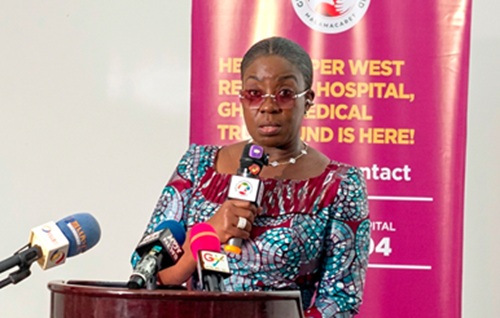
The Ghana Medical Trust Fund (GMTF) has announced an expansion of its specialist healthcare support package to cover additional cancers and other chronic non-communicable diseases to improve access to treatment for vulnerable patients.
The expansion includes additional cancer conditions, cardiovascular diseases, and neurosurgical conditions such as hydrocephalus and kidney transplants.
The intervention is expected to ease the financial burden on patients and their families who require specialised medical care.
The Administrator of the Fund, Adjoa Obuobia Darko-Opoku, announced this at a stakeholder engagement and town hall meeting organised by the Fund in Wa in the Upper West Region.
About the Fund
Ms Darko-Opoku said the Fund was established under the vision of President John Dramani Mahama to provide financial assistance to eligible patients living with chronic non-communicable diseases, particularly cancer, kidney diseases, and cardiovascular conditions.
She explained that its mandate extended beyond direct financial assistance to patients to include investment in medical equipment, infrastructure and specialist training, as well as research and innovation.
Ms Darko-Opoku, therefore, urged health professionals, traditional authorities, religious leaders, civil organisations, and the media to help educate the public on the Fund’s eligibility requirements and application procedures.
The Health Policy Advisor of the Fund, Dr Norbert Kipo, said chronic non-communicable diseases had become a major public health and economic concern, with their treatment often pushing affected families into financial difficulties.
He said the fund was established to address the gap in healthcare financing, particularly when patients with conditions such as hypertension and diabetes developed complications and required specialised treatment.
He explained that while the National Health Insurance Scheme provided coverage for some healthcare services, patients requiring complex specialist interventions often faced significant financial challenges.
Dr Kipo said the Upper West Regional Hospital was among the accredited facilities under the Fund to provide specialist care to eligible patients in the region.
Significance
The Upper West Regional Minister, Charles Lwanga Puozuing, said the initiative came at a critical time when chronic non-communicable diseases continued to impose significant financial, social, and emotional burdens on individuals and families.
He said the success of the Fund would depend largely on public awareness, effective coordination, and transparency in its administration.
Mr Puozuing expressed the commitment of the Regional Coordinating Council to collaborate with health institutions and other stakeholders to ensure that the initiative translated into tangible benefits for residents.
The Upper West Regional Director of Health Services, Dr Josephat A. Nyuzaghl, said the Ghana Health Service would collaborate with the Fund to intensify public education and facilitate the early identification and referral of patients with non-communicable diseases.
He said early detection was important in reducing complications, the cost of treatment and easing the financial burden on patients.
The acting Medical Director of the Upper West Regional Hospital, Dr K. K. Baabiineh, said the hospital was committed to supporting the implementation of the Fund’s mandate and ensuring that eligible patients received the necessary care.
Testimony
An Information and Communications Technology (ICT) teacher at Wa Technical Institute and a beneficiary of the Fund, Mumuni Jamil, recounted how the intervention had helped him access a second life-saving surgery for an arteriovenous malformation (AVM), a condition involving an abnormal connection between arteries and veins.
