
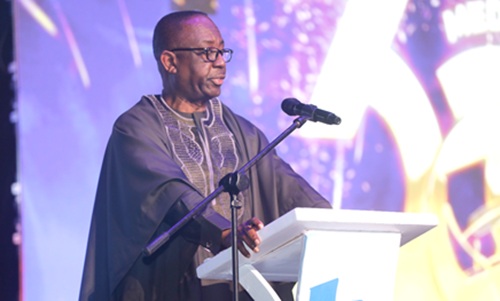
The Executive Chairman of KGL Group, Alex Apau Dadey, has called for stronger collaboration between the media and the corporate sector to support national transformation and foster lasting economic prosperity.
This, he said, would enable the media and corporate institutions to strengthen the economy without compromising the media's independence and responsibility to hold power accountable.
Mr Dadey was speaking at the 30th Ghana Journalists Association (GJA) Media Awards in Accra last Saturday, on the theme: "Celebrating excellence, advancing media freedom and combating hate speech in the digital age".
The event was attended by the President, John Dramani Mahama; the Speaker of Parliament, Alban Bagbin; the Chief Justice, Justice Paul Baffoe-Bonnie; government officials,
Members of Parliament, traditional leaders, and members of the diplomatic corps.
The Ga Mantse, King Tackie Teiko Tsuru II, chaired the event, while the Asantehene, Otumfuo Osei Tutu II, Patron of the GJA, was represented by the Nkoranzamanhene, Nana Kwame Baffoe IV.
KGL Group was the headline sponsor of the awards in the association's annual recognition of excellence in journalism.
Mr Dadey said the group's sponsorship reflected its belief that a strong, independent and responsible media was indispensable to democracy, a competitive economy and a prosperous nation.
He received an honorary award for his contribution to the media and national development.
Roles
The businessman said the two sectors had complementary roles in national development, with the media providing independent scrutiny and helping the public to understand economic issues, while businesses created jobs, supported livelihoods and drove investment and innovation.
Mr Dadey said the media had an institutional responsibility to expose wrongdoing and protect the public interest, but also had an important developmental role in recognising excellence, celebrating enterprise and telling the stories of successful Ghanaian businesses.
He said stronger engagement between the media and the corporate sector, supported by better economic understanding, would help journalists to report more accurately on the contribution of businesses to the economy.
“When the media understand business better, the public understands the economy better,” Mr Dadey added.
As part of that collaboration, he proposed a structured economic journalism programme involving the GJA, corporate institutions, universities and the central bank.
The programme, Mr Dadey said, should equip journalists to interrogate financial statements, analyse economic policies and understand market complexities and the challenges involved in building sustainable businesses.
He said business reporting should go beyond headlines about revenue and tax contributions to examine issues such as capital mobilisation, investment risks and regulatory compliance.
Mr Dadey said SMEs were important sources of employment, innovation and livelihoods, but needed support to expand their operations and compete in larger markets.
Large enterprises, he said, could provide the supply chains, markets, technology and institutional capacity that enabled smaller businesses to grow.
Mr Dadey further said such relationships were important for building a stronger domestic business ecosystem and enhancing the capacity of Ghanaian enterprises to compete internationally.
