
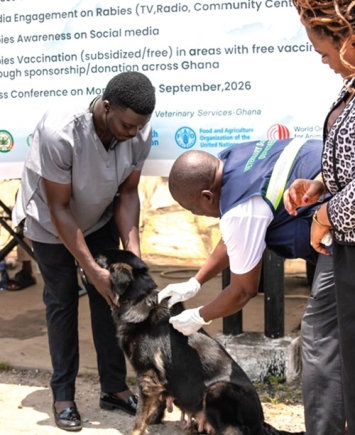
The Veterinary Services Department has launched this year’s Mass Rabies Vaccination Campaign for dogs and cats in high-risk areas across the country with a target to vaccinate 25,000 animals free of charge this month.
The campaign is an important step towards achieving zero human deaths from dog-mediated rabies by 2030 and forms part of Ghana’s observance of World Rabies Month 2026, on the theme, “Stronger Together.”
Launching the campaign and World Rabies Month commemoration in Accra last Monday, the Chief Veterinary Officer, Dr Emmanuel Allegye-Cudjoe, said rabies remained one of the oldest and most feared diseases known to humankind and for good reason.
Symptoms
He said once clinical symptoms appeared in an infected person or animal, the disease was virtually 100 per cent fatal, with no effective cure at that stage.
“Yet rabies is also entirely preventable through timely vaccination.
This is the central challenge before us: although rabies cannot be cured after symptoms develop, we have the means to prevent it before it claims a life.
“In Ghana, as elsewhere, infected dogs are the principal source of human rabies transmission.
Each year, Ghanaian lives, particularly those of children, are lost to this preventable disease, often because dogs are not vaccinated, or appropriate post-exposure treatment is sought too late,” he said.
Those avoidable deaths, Dr Allegye-Cudjoe said, must end.
Through responsible pet ownership, sustained mass dog vaccination, public education and prompt post-exposure care, he said the country could eliminate dog-mediated human rabies.
Target
“We must act together, and we must act now,” he emphasised, and that after September the prescribed vaccination fees would apply.
He said the vaccines and required logistics were ready for deployment to the regions as part of the department’s retooling initiative led by the Minister of Food and Agriculture, Eric Opoku, to strengthen animal-health service delivery.
The campaign, he said supported the country’s commitment to eliminate dog-mediated human rabies by 2030.
“Public education will also be intensified through religious and educational institutions, traditional and social media and community engagement.
Educational materials, including videos and audio messages in Twi, Ga, Ewe and Hausa, have been developed for schoolchildren, healthcare providers and the general public.
Pet owners
“To every dog and cat owner: vaccinate your pet against rabies annually.
This is both a public health responsibility and a legal requirement under applicable MMDA bye-laws. Compliance protects your family, community and especially children from rabies.
“Please take advantage of this campaign by taking your pets to the nearest designated veterinary centre for free or subsidised vaccination,” he said.
The campaign, he said, could not succeed through government resources alone and called on metropolitan, municipal and district assemblies (MMDAs), civil society, religious and traditional leaders, development partners and the private sector to support enforcement, community mobilisation, advocacy, financing, vaccines and logistics.
A Deputy Director at the Ministry of Local Government, Chieftaincy and Religious Affairs, Esi Boni-Morkla, said MMDAs were at the frontline of community-level public health and environmental management.
Through their Environmental Health Departments, she said the assemblies played an important role in public education, community mobilisation, surveillance and reporting, responsible dog ownership, enforcement of relevant bye-laws and collaboration with veterinary and health authorities.
