

One year after completing the full vaccination schedule, the malaria vaccine (RTS,S/AS01E) significantly reduced malaria, severe malaria, malaria-related hospitalisations and anaemia among children, and it remains safe.
The study was conducted in real-life settings in Ghana, Kenya and Malawi – in communities and health facilities where the vaccine is routinely given to assess how well the vaccine performs and how safe it is in everyday use.
Researchers say the findings confirm that the protection from the vaccine lasts beyond the initial vaccination period and that the benefits of preventing malaria and its severe complications continue to outweigh any risks.
Making a presentation on the effectiveness and safety of the malaria vaccine at this year’s annual meeting of the American Society of Tropical Medicine and Hygiene (ASTMH), a senior researcher of the Kenya Medical Research Institute (KEMRI), Dr Bernhards Ogutu, said the overall benefit risk profile remained favourable and that “these findings support the continued use of the RTS,S/AS01E to prevent and control malaria in children under five in endemic settings.”
The 2026 ASTMH meeting, which is taking place at the Gaylord National Harbour, Maryland, USA, is on the theme: “Advancing Science for Tropical Medicine and Health”.
About 3000 participants, including researchers, clinicians, public health professionals and global health advocates, are attending the meeting in-person with thousands online.
Vaccine safe
In 2021, the World Health Organisation (WHO) recommended the widespread use of the malaria vaccine for children from five months of age living in areas with moderate to high transmission of the malaria parasite.
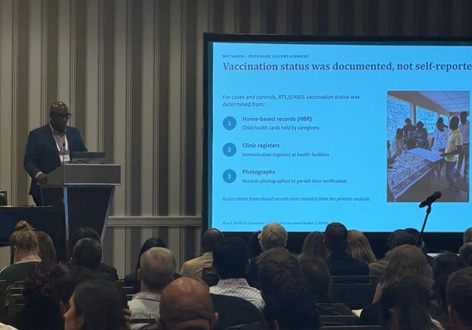
Prof. Kwaku Poku Asante (left), Director, Kintampo Health Research Centre, making a presentation at the 2026 annual meeting of the American Society of Tropical Medicine and Hygiene
Dr Ogutu said the study followed nearly 45,000 children: 22,503 in communities where the vaccine was introduced and 22,495 in communities where it was not across Ghana, Kenya and Malawi.
He said in the vaccinated communities, 64.3 per cent of children received all four doses.
He explained that even though only about two in three children got all four doses, the vaccine still significantly reduced malaria, severe malaria, hospitalisations and anaemia.
Dr Ogutu said from after the third dose up to one year after the fourth dose, the vaccine reduced all malaria cases by 14 per cent and severe malaria by 27 per cent.
He said the vaccine also reduced malaria-related hospitalisation by 22 per cent and anaemia among hospitalised children by 23 per cent.
That, he said, showed that the vaccine not only prevented infection, but prevented the serious complications that put children in hospital and caused low blood.
Fourth dose extra protection
In another presentation that used another scientific approach, the “Case-control studies of the effectiveness of the RTS,S/AS01E malaria vaccine against severe malaria in Ghana, Kenya and Malawi”, the Director of the Kintampo Health Research Centre (KHRC), Prof. Dr (Med) Kwaku Poku Asante, said the study found significant effectiveness of the malaria vaccine among children who received three doses and a fourth dose provided additional benefit on severe form of malaria.
He said the vaccine still had a good safety profile.
Prof. Asante said the findings supported completing the full four-dose schedule of the malaria vaccine.
