
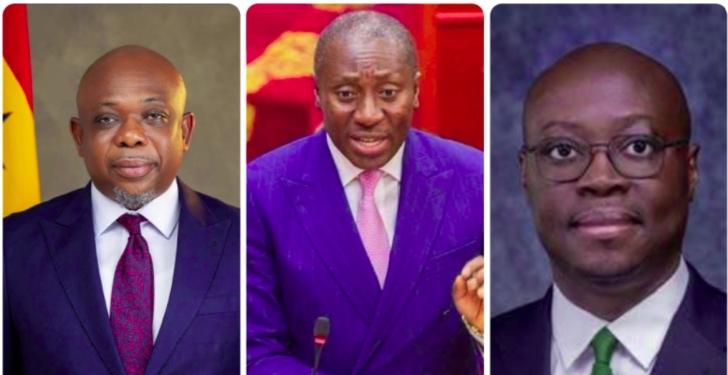
The two sides of Parliament traded punchlines that echoed familiar sentiments as they rounded up the debate on the 2027 Budget Statement on the floor yesterday.
Majority Leader James Agalga described the Budget as one of restraint with purpose that proved that the country could build without mortgaging tomorrow, but his Minority counterpart, Alexander Afenyo-Markin, challenged the government to give the private sector real incentives, warning that without that sector, the 24-Hour Economy and the newly christened “New Economy” would remain empty promises.
Winding up debate on the 2027 Budget on the floor of Parliament, Mr Agalga said the Budget was “not dressed in slogans, but rooted in the real lives of Ghanaians”.
“This is the people’s budget. No new taxes, no borrowing for the Accra-Kumasi Expressway, no borrowing for the Western Corridor railway line,” the Majority Leader said in his first substantive debate since assuming the position in August this year.
For too long, Mr Agalga said, Ghanaians had been told that progress must come with pain, that development must be financed by more debt, and that the only way forward was to load the next generation with more debt.
“This budget rejects this thinking. It is a budget of restraint with purpose. It is a budget that says we can build without mortgaging tomorrow,” he said.
Inflation down, debt down
Mr Agalga, who is the MP for Builsa North, said the government’s economic management had delivered on its core promises.
“When President Mahama took over the reins of governance in this country, he and his Finance Minister promised to bring inflation down. We have delivered,” he said.
Inflation stood at 5.5 per cent in October, he said, 2.5 percentage points lower than the 8.0 per cent recorded in October last year, and a far better situation from the crisis levels the country endured before 2025.
“We promised to cut profligate spending, and we have delivered. We promised to reduce borrowing. We have delivered,” he said.
Public debt, Mr Agalga said, now stood at GH¢759.3 billion, equivalent to 47.5 per cent of Gross Domestic Product (GDP) at the end of October.
Cedi stable, reserves strong
On the external front, Mr Agalga said the country’s position had been transformed.
He said gross international reserves stood at $12.7 billion by the end of September, forming about 4.5 months of import cover.
“Your (NPP) records in terms of import cover was just three weeks. Now compare three weeks to 4.5 months of import cover. A promise made is a promise kept,” he said.
He challenged former Finance Minister, Ken Ofori-Atta, who superintended the economy for seven years under the NPP, to return home to account for his stewardship, just as Dr Forson had done with courage and grace.
Building without borrowing
The Majority Leader said the strength of the economy was also visible in what the government was building without new borrowing.
Under the Budget, $1 billion had been earmarked for the construction of the multi-purpose Pwalugu Dam — the same dam the NPP promised, cut sod for at Pwalugu, and then abandoned after contractors disappeared, he said.
On Agenda 111, he said the NPP spent more than GH¢4 billion but could not finish even one hospital, but today, five were ready for commissioning, and $1 billion had been earmarked to complete 35 more.
He contrasted that with the NPP’s abandonment of the E-blocks started by President John Mahama in his earlier term, in breach of Article 36(7) of the Constitution, which enjoins successive governments to continue projects commenced by previous governments.
No drive for jobs
The Minority Leader who started the debate said after two years in office, the government had produced no single private sector policy to drive jobs, investment and growth.
“I want to ask the government, to the Trade and Industry Minister: Is there a single policy for the private sector announced and implemented?
“Two years, there is no single private sector policy. You are a government of rhetoric, empty promises; that is who you are,” he said.
Mr Afenyo-Markin said the 2027 Budget’s biggest flaw was its philosophy: a public sector-driven “New Economy”.
He cited the Budget’s proposal for the Social Security and National Investment Trust (SSNIT) to invest in new hotels as proof of policy misalignment, especially as it came with tax incentives. SSNIT, he said, had itself publicly published the poor performance of its existing hotels, and added that it wanted to privatise them.
“If this government is serious about job creation and allowing the private sector to fully participate to create jobs, it will not come here with a policy saying that public institutions that have already publicly admitted state funds are going waste (should build more hotels),” he said.
24-Hour Economy needs
Mr Afenyo-Markin argued that a 24-hour Economy built on the promise of one job, three shifts could not work on announcements alone, but on deliberate incentives to make it profitable for businesses to stay open around the clock.
“If you want me to operate a 24-Hour Economy, what do you need to do? On electricity tariffs, you give me rebates.
You need to give me some preferential rates on income tax. You need to look at my imports, the equipment I bring in, the raw materials. You need to incentivise.
“There is no single incentive. And in 2025 they did not provide any incentive for the private sector.
How do you achieve a 24-Hour Economy?” he asked.
Cancelling 1D1F
The Minority Leader accused the government of cancelling the One District, One Factory (1D1F) programme of the previous regime without putting anything in its place.
He also pointed to the promised Women’s Bank, which he said was loudly announced to give women access to loans, but two years on, “nothing for the woman”.
