
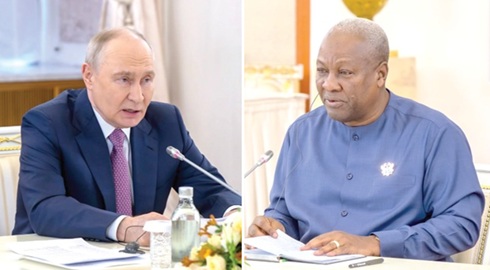
Ghana and Russia have agreed to move their long-standing relationship from political to economic cooperation, with the signing of commitments for several projects during the just-ended Russia-Africa Summit.
The commitments between the two countries include an agreement to work towards a 2,000-megawatt nuclear power plant to guarantee energy security and anchor industrialisation.
The nuclear power plant project is a revival of Dr Kwame Nkrumah’s vision, which was truncated by the 1966 coup.
Other commitments are a new defence agreement to acquire strategic military assets for the Ghana Armed Forces; enhanced agricultural cooperation to boost grain production and fertiliser supply; increased scholarships for Ghanaian students; and a declaration by President Putin that Ghanaians are no longer allowed to participate in the war in Ukraine, whether through irregular recruitment or voluntary interest.
The two countries also agreed to revive the Permanent Joint Commission for Cooperation, which Moscow is ready to host in the next few weeks.
The two sides firmed up the commitments in Moscow last Friday when President John Dramani Mahama held bilateral talks with Russian President Vladimir Putin at the Kremlin, after the conclusion of the 3rd Russia-Africa Summit.
President Mahama told his counterpart that conditions were now ripe for Ghana and Russia to move their longstanding partnership from political cooperation to economic cooperation.
He said Ghana was the eighth largest economy in Africa with a Gross Domestic Product (GDP) of about $120 billion, a stable economic environment and a growth rate of about six per cent per annum.
“We believe that the time has come for us to move from just political cooperation to economic cooperation. And the environment is right for us to have mutual investments between Russia and Ghana,” President Mahama said.
He said the summit would serve as the bridge for economic cooperation between Africa and Russia, and expressed confidence that it would promote cooperation in trade, investments, agriculture, energy, infrastructure, education, health, science and technology.
President Mahama also told President Putin that Ghana would hold the Permanent Joint Commission for Cooperation meeting next year, and expressed the hope that it would provide a proper framework for cooperation going forward.
Solidarity
President Mahama commended Russia’s solidarity with Africa during the period of decolonisation, recalling that Russia stood by Africa in the fight against apartheid.
He also stated that when the COVID-19 pandemic struck, the first vaccines received in Africa were the Sputnik V vaccines from Russia.
“It just shows that Russia is always in solidarity with Africa and we appreciate that,” he told President Putin.
President Mahama also recalled the Ghana-Russia relations, saying Ghana was the first Sub-Saharan African country to break from colonialism, and that as early as 1958 Russia recognised Ghana and established diplomatic relations with her.
He said in 1961, Ghana’s first President, Dr Kwame Nkrumah, visited Russia and met with the First Secretary of the Communist Party of the Soviet Union, Nikita Khrushchev, a historic visit by the first African leader, and said relations had since grown from strength to strength.
Support for education, military
President Putin, for his part, expressed his gratitude for meeting with President Mahama, and recalled the long-standing diplomatic relations between Ghana and Russia which dated back to 1958.
He said Russia would particularly focus on improving relations through support for Ghana’s education and military development, including skills training for Ghanaian students and capacity building for the civil service.
“For this, I am glad to meet you, Mr President,” Mr Putin said.
He added that trade volume between Ghana and Russia had increased by six per cent between January and August, which was one of the highest in Sub-Saharan Africa, describing the trend as generally positive.
President Putin also expressed gratitude to Ghana for supporting Russian-sponsored resolutions at the United Nations.
