
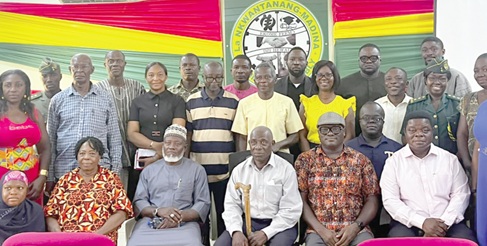
Residents of the La Nkwantanang-Madina Municipality have raised concerns over the implementation of petroleum revenue-funded projects, citing inadequate information on project costs, contractors, as well as project delays and questions about value for money.
The concerns were raised at a town hall meeting organised by the Public Interest and Accountability Committee (PIAC) to engage residents on the utilisation of petroleum revenues and projects funded with those proceeds in the municipality.
Some residents questioned how much had been spent on projects that remained incomplete, while others expressed concern about inadequate information to enable communities to track project implementation and hold contractors accountable.
Residents also expressed concerns about weak supervision, limited involvement of the municipal assembly in projects initiated at national level and inadequate community participation in project selection and implementation, which they said undermined local oversight and accountability.
The meeting further highlighted concerns over the allocation of petroleum revenues to the District Assemblies Common Fund (DACF), with PIAC indicating that the proportion allocated as of December 2025 fell below the required minimum of five per cent.
Inadequate information
At the meeting held last week Thursday (October 15), the Chairman of PIAC, Richard Ellimah, said the committee had identified three major concerns with projects in the municipality: the assembly’s limited knowledge of their petroleum revenue component, inadequate information available to engage residents and questions about value for money.
He said the assembly appeared unaware that some projects had petroleum revenue components because they had been introduced from Accra.
He added that although residents knew that some construction activities were taking place, they lacked information about the contractors, project costs and other details.
Mr Ellimah called on assemblies to improve engagement with communities and provide information on project funding and implementation.
On the allocation of petroleum revenues to the DACF, Mr Ellimah said a Supreme Court decision established that petroleum revenues formed part of national revenues.
He said the decision required that no less than five per cent of petroleum revenues be allocated to the DACF.
However, PIAC’s checks as of December 2025 showed that less than two per cent had been allocated, prompting the committee to call on the Minister of Finance to comply with the law.
Weak project supervision
A member of the Ghana Academy of Arts and Sciences, Professor Peter Quartey, said district development plans were often disregarded during project selection, despite needs assessments and consultations with communities.
He said the ability of communities to lobby for projects sometimes appeared to carry more weight than the priorities outlined in district plans.
Prof. Quartey also expressed concern about projects contracted at the national level without adequate involvement of assemblies and district engineers, resulting in weak supervision.
