
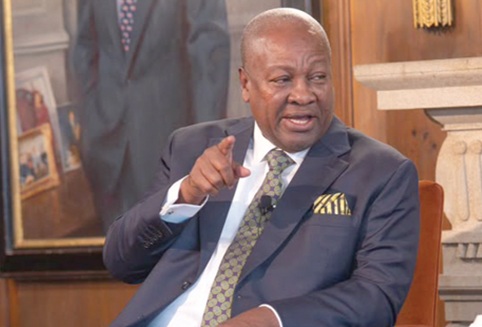
President John Dramani Mahama has said the intended listing of 10 state-owned enterprises (SOEs) on the Ghana Stock Exchange (GSE) would transform them into public companies, enforce accountability and reduce political interference in their management.
That plan, the President said, formed part of reforms to improve governance, profitability and attract investment in the SOEs.
President Mahama was speaking in New York last Friday on Ghana's investment climate and energy access at the Council on Foreign Relations, an independent and nonpartisan American think tank, in a session dubbed “A Conversation with President John Dramani Mahama”.
Also, President Mahama said the decision would help insulate SoEs from the politics of the country, explaining that Ghana's democratic cycle, which sees parties alternate in power, often leads to the sacking of chief executive officers and dissolution of boards when a new government takes over.
Listing, he said, would make such interference difficult.
Additionally, citing the poor work culture and entitlement in some state entities, he said the listing was necessary.
"There's this notion of state enterprises where people just go and they are guaranteed a monthly salary whether they perform well or not.
Even when they are making losses, they are asking for salary increments and asking for bonuses when you have made a loss," he said.
President Mahama said there had been a turnaround in the performance of SOEs. He disclosed that at the recent State Interest and Governance Authority (SIGA) programme, it was reported that SOEs collectively posted a net profit of almost GH¢19 billion, after years of collective losses.
He said 10 enterprises have now been prepared for listing.
“They'll become public companies, one, because we want to improve their governance and two, because we want to reduce political interference in those state-owned enterprises," he said.
He added that listing would also allow Ghanaians to buy shares and benefit from the performance of the companies.
The President added that the Ghana Stock Exchange was the best-performing exchange in Africa last year and had bounced back strongly, with three Initial Public Offerings (IPOs) completed in record time.
"It's a good place to invest. Some of them are paying quite good profits," he said.
Investment
President Mahama said the country remained attractive to investors because of its stable power supply and extensive coverage.
"Happily, Ghana is one of the countries that started early in terms of providing stable power and affordable power across the length and breadth of our country and so Ghana has more than 90 per cent electricity coverage," he said.
He explained that the remaining 10 per cent not yet connected to the national grid were in areas where grid extension was impractical and the government was deploying green solutions, including solar and other off-grid options.
President Mahama said the availability of reliable power was a key factor in the sharp rise in Foreign Direct Investment (FDI), which increased from $640 million in the crisis year of 2024 to $2.6 billion by the end of 2025.
"It's obvious that there's something good happening in Ghana," he said.
