

Operators of various businesses at Laboma Beach in the La Dade-Kotopon Municipality of the Greater Accra Region are counting their losses following the demolition of structures believed to be located within the buffer zone of the Kpeshie Lagoon.
The exercise was carried out by the government’s Post-Flood Mitigating Task Force, headed by General Okai Yeboah, Director-General of the Joint Operations of the Ghana Armed Forces, with the 48th Engineer Regiment serving as the executing unit.
Using excavators and bulldozers, the military, supported by the police, demolished a number of structures, including beachfront nightclubs, hotels, restaurants and other hospitality facilities.
The demolition at Laboma Beach forms part of a series of operations being undertaken by the task force in areas that include Boundary Road in East Legon and Oyarifa.
The operations are focused on desilting and dredging water bodies, as well as removing structures identified as obstructing waterways, as part of measures to mitigate flooding.
21-day notice
In August, the Greater Accra Regional Security Council (REGSEC) served a 21-day notice to occupants of the Laboma Beach to vacate the buffer zones or face forcible removal.
The Greater Accra Regional Minister, Linda Obenewaa Akweley Ocloo, who led the REGSEC team to serve the notices, said the affected facilities had been built in areas meant to serve as buffer zones for the Kpeshie Lagoon, and that their continued presence was worsening flooding in the area.
Mrs Ocloo said some of the developers had been cautioned at the foundation stage of their projects, but had defied the warnings and gone ahead with construction.
Visit
When the Daily Graphic visited the site yesterday, devastated and frustrated owners of the affected businesses and their workers were hurriedly packing their belongings and salvaging whatever they could as the demolition exercise continued.

Owners of the famous Pink Flamingo Hotel, Bliss Escape Restaurant and other hospitality facilities expressed disappointment with the statutory authorities and traditional leaders, whom they accused of failing in their efforts to save the buffer zone.
A staff of Bliss Escape Restaurant, who agreed to speak with the Daily Graphic on condition of anonimity, challenged the justification that the demolished structures were responsible for blocking the waterway and contributing to flooding.
He argued that the structures affected by the exercise had not obstructed the waterway, describing the area identified as a buffer zone as one that had not received water for more than 50 years.
Livelihoods
The Public Relations Officer (PRO) of Laboma Beach, Nathaniel Nettey, said the demolition exercise would have a significant impact on businesses and the livelihoods of more than 3,000 people who worked within the area.
He said although not all structures at Laboma Beach had been touched, the exercise would affect the wider business ecosystem, including permanent staff, associated workers and other individuals whose livelihoods depended on activities at the beach.
Mr Nettey said the businesses operating at the beach contribute payments to the state and other statutory authorities, and expressed concern about the economic consequences of the demolitions on both workers and operators.
"Over 3,000 people work here. Yes, it's not every structure that has been demolished. Nonetheless, it would affect general business. So, all 3,000 people here would be affected. We have in-house staff, people we associate with and all of that," he said.
He pointed instead to structures located across the road, which he claimed were built directly within the waterway but which remained standing despite the demolition exercise at Laboma Beach.
He questioned the effectiveness of demolishing structures at the beach if other developments that allegedly obstruct the waterway were left untouched.
While acknowledging the authority of the state, Mr Nettey said the management of Laboma Beach would engage with government officials to determine the way forward and assess the impact of the demolitions on businesses and workers.
Necessary exercise
Meanwhile, the Ghana Armed Forces’ 48 Engineer Regiment says demolitions have become necessary to remove structures that have encroached on and blocked the natural waterway, contributing to flooding.
Commanding Officer of the 48 Engineer Regiment, Lieutenant-Colonel Frank Osei Amponsah, in an exclusive interview with the Daily Graphic, said the exercise formed part of the government’s Post Flood Mitigating Task Force launched after the severe floods in June and July this year.
He explained that the Kpeshie Lagoon had been narrowed through filling and construction, restricting the flow of water into the sea.
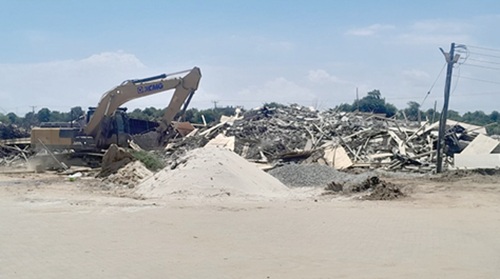
Heavy machinery were deployed for the exercise
He stated that the military was, therefore, demolishing structures that obstructed the waterway, and would subsequently widen the channel to restore its natural course and help to reduce future flood risks.
Lt-Col Amponsah stressed that the exercise was “strategic demolition”, targeting only structures identified as blocking the waterway, rather than a general demolition exercise.
He added that the 48 Engineer Regiment rescued 121 people during the June 29 floods, highlighting the scale of the impact on lives and property.
He urged the public to comply with building regulations and refrain from constructing on waterways, stressing that the national interest must take precedence over individual interests.
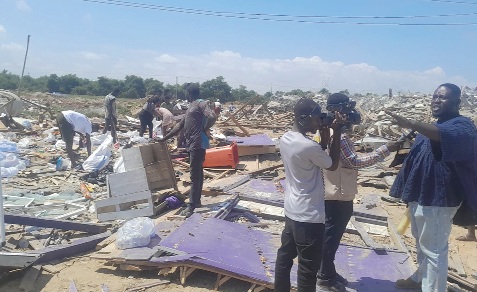
The exercise affected a vast area of land
"We should adhere strictly to the laws of the land.
We should all refrain from building on waterways, and if we do so, we will not find ourselves in the situation we find ourselves in today," he said.
