
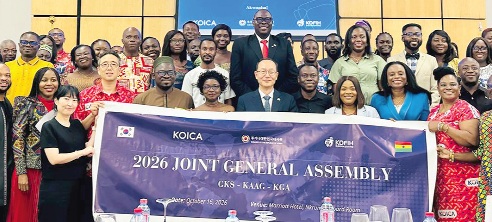
Korean scholarship alumni in Ghana have been urged to apply the knowledge and skills acquired through their studies and professional training in South Korea to strengthen local institutions to accelerate national development.
The Country Director of the Korea International Cooperation Agency (KOICA) in Ghana, Dongwan Woo, made the call in Accra last Friday at the 2026 Joint General Assembly of alumni of KOICA, the Korea Foundation for International Healthcare (KOFIH) and the Global Korea Scholarship (GKS) programme.
The gathering brought together, for the first time, alumni of the three Korean programmes to share experiences, showcase their contributions in Ghana’s development and explore opportunities for collaboration.
Mr Woo said the assembly provided an important platform for alumni from different programmes to connect, exchange ideas and build partnerships that could translate their Korean learning experiences into practical solutions to Ghana’s development challenges.
He disclosed that KOICA alone had trained approximately 1,700 Ghanaian officials and professionals since 1998 in areas, including health, education, agriculture and public administration.
“The true value of these programmes lies not only in the knowledge acquired in Korea but also in how that knowledge is applied to strengthen our institutions and contribute to national development,” he said.
The Country Representative of KOFIH in Ghana, Hyang Lee, also welcomed the alumni and thanked them for participating in the gathering.
Invest in people
The Ambassador of the Republic of Korea to Ghana, Park Kyongsig, highlighted the shared experiences and cultural connections between the two countries, including the alumni’s appreciation of Korean culture and cuisine.
He said Korea’s development experience demonstrated the importance of investing in human capital, particularly given the country's limited natural resources and habitable land.
Mr Park said Korea had prioritised the development of its people as a means of overcoming economic and environmental challenges and building a strong economy.
He drew parallels between the development experiences of Ghana and South Korea, observing that both countries had faced challenges that required sustained efforts, institutional reforms and changes in attitudes towards work and efficiency.
Mr Park urged the alumni to become catalysts for Ghana’s development by using their education, professional experience and exposure to South Korean institutions to improve the lives of their fellow citizens.
He said the benefits of international education should extend beyond individual career advancement to contribute to the progress of the wider society.
Alumni showcase impact
The presidents of the three alumni associations presented reports on their activities and achievements, highlighting initiatives in education, health care, environmental protection, public sector reform and community development.
As part of their efforts to promote knowledge transfer, the associations organised a public seminar to examine how scholarship beneficiaries were applying lessons from South Korea in their respective institutions.
Presentations at the seminar included an Integrated Cost Management System by the Industrial Finance sector and public sector reforms by the Local Government Service.
The seminar also featured a panel discussion involving heads of departments and chief directors, who shared experiences on applying knowledge gained in South Korea to improve institutional performance and service delivery.
The associations said the initiatives were intended to ensure that the benefits of Korean scholarships and training programmes translated into measurable improvements in Ghanaian workplaces and communities.
