
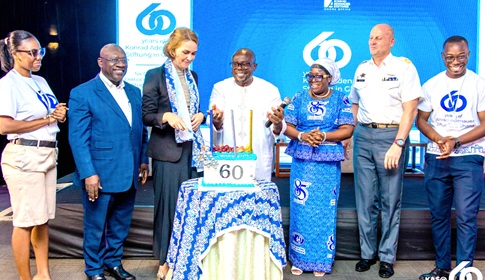
The Konrad-Adenauer-Stiftung (KAS), a German political foundation, has marked 60 years of partnership with Ghana, highlighting its contribution to democratic governance, policy development and institutional collaboration.
The foundation, which established its office in Accra in 1966, has worked with political institutions, civil society organisations, traditional authorities and academic institutions to promote democratic dialogue and contribute to the country’s political, social and economic development.
The anniversary celebration, held at the Fiesta Royale Hotel in Accra last Tuesday, October 27, was on the theme: “60 Years of Konrad Adenauer Stiftung in Ghana: Six Decades of Democratic Dialogue – Shaping Political, Social and Economic Development Together”.
Partnership
The Resident Representative of KAS, Anna Wasserfall, said the anniversary celebrated not only the foundation’s longevity but also the relationships it had built with partners across generations and changing political circumstances.
“Sixty years of the Konrad-Adenauer-Stiftung in Ghana do not simply represent 60 years of a German organisation working in a partner country.
They represent 60 years of cooperation. Sixty years of dialogue, of exchanging ideas, of learning from one another, and of working towards shared goals,” she said.
She said the country remained one of the foundation’s longest-standing partners worldwide, adding that its work in the country had been made possible by the contributions of institutions and individuals who shared its commitment to democracy, freedom, the rule of law and human dignity.
Ms Wasserfall said the anniversary also provided an opportunity to reflect on emerging challenges, including changing patterns of political participation, technological transformation and economic and social inequalities.
She said addressing those challenges required dialogue, cooperation and a willingness to engage with different perspectives.
Collaboration
The Rector of the Ghana Institute of Management and Public Administration (GIMPA), Prof. Samuel K. Bonsu, said the institution valued its longstanding partnership with KAS in promoting democratic governance and human development.
He said the collaboration had provided platforms for ideas, citizen mobilisation, political leadership development and discussions on how Ghana could address its challenges within a democratic framework.
He cited illegal mining, political party financing and political leadership development as some of the areas in which the two institutions had collaborated.
“Our responsibility extends beyond educating students to include generating knowledge, questioning established assumptions and contributing practical solutions to Ghana’s development,” he said.
Prof. Bonsu said an informed citizenry, evidence-based policymaking, ethical leadership and strong public institutions were essential to good governance.
He attributed the partnership’s continuity to a shared purpose, mutual trust and the willingness of both institutions to adapt to changing circumstances.
Development
The Programmes Director of KAS, Dr Joseph Damoe, said the foundation’s work in the country had evolved over the six decades to reflect changes in society.
He said its engagements had expanded from working with the Catholic Church, rural communities, women’s groups and youth groups to partnerships with traditional authorities, political parties and academic institutions.
Dr Damoe cited the foundation’s involvement in discussions on local government, the National Health Insurance Scheme and technical and vocational education and training (TVET) as examples of its contribution to national development.
He recalled that the foundation had engaged with stakeholders during Ghana’s efforts to develop its local government system in the 1980s.
He said the foundation’s future programmes would need greater local ownership to ensure that they produced meaningful results.
“Our biggest challenge as a foundation is also to try as much as possible to bring in local ownership, ownership of the ideas, ownership of the planning, and ownership of the results,” he said.
Dr Damoe said the objective was to ensure that the foundation’s activities translated into outcomes that contributed to the transformation of society.
