
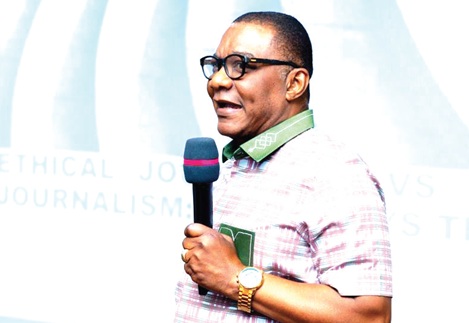
A Member of the National Media Commission (NMC), Kobby Asmah, has advised journalists to uphold professionalism, integrity and ethical standards, warning that trading credibility for money could undermine their careers and public trust in the media.
He cautioned practitioners against sensationalism, clickbait headlines, political partisanship and allowing money or personal relationships to influence editorial decisions.
Mr Asmah, a former Editor, Graphic, explained that although unethical practices might offer immediate financial rewards, they could undermine journalists’ credibility, expose them to legal liabilities and damage their long-term professional prospects.
“When you are trusted in your work, that is the currency and that is the true value of money which can only be built through adherence to professional standards,” he said.
Don’t mortgage your future
Addressing members of the Parliamentary Press Corps (PCC) at a capacity training in Accra last Friday, Mr Asmah warned that journalists who traded favourable coverage for money or other benefits risked becoming dependent on politicians, business people and other influential individuals, thereby compromising their editorial independence.
Such practices could lead to blackmail journalism in which journalists threatened to publish damaging information unless their subjects paid them, as well as political mercenary journalism in which reporters become mouthpieces for political parties in exchange for money or access.
“Unethical journalism pays your bills today but mortgages your future; ethical journalism protects your credibility for a lifetime,” he said.
Professional opportunities
Mr Asmah said no serious company would pay good money to advertise on a media platform that had lost credibility.
He acknowledged that the difficult financial conditions facing many journalists in Ghana could make temptations to accept money difficult to resist.
He, however, maintained that ethical journalism offered more sustainable professional opportunities, including consultancy work, fellowships, writing engagements and invitations to moderate high-profile events.
Verify information
Drawing on his professional experience, Mr Asmah recounted how an earlier reporting assignment had taught him the importance of cross-checking allegations, particularly where a person's reputation was at stake.
To avoid such a slip, he reminded journalists that they had a responsibility to contact the person at the centre of an allegation, regardless of the source of the information in order to establish the facts and give the affected party an opportunity to respond.
In his view, even a story containing truthful information, could raise ethical concerns if journalists failed to consider its context, exercise sound judgement and fulfil their responsibility to report fairly.
“You must guard against conflicts of interest arising from friendships, political affiliations, personal associations and other relationships that can influence your professional judgement,” he said.
To him, journalists could maintain relationships with politicians, traditional authorities, religious leaders and businesspeople without surrendering their editorial independence.
Such relationships, he added, should provide opportunities for constructive engagement, accurate reporting and the development of balanced stories that served the public interest.
“Editorial decisions should be guided by established news values, including proximity and national significance as well as the public interest rather than the demands or financial influence of individuals seeking publicity,” he said.
Fourth Estate
On the broader responsibilities of the media, Mr Asmah said the media was considered the Fourth Estate because journalism was central to democratic governance as it informed citizens, shaped public opinion and held institutions and individuals accountable.
He urged practitioners to uphold accuracy, impartiality, fairness, justice and accountability while respecting the dignity of individuals, protecting confidential sources and observing copyright laws.
He also emphasised the need for journalists to use responsible language in headlines and reports, cautioning that misleading wording could distort the meaning of a story and unfairly damage the reputation of the subject.
Mr Asmah stressed that the media's commitment to freedom of expression must go hand in hand with ethical responsibility, noting that the public's right to information did not remove journalists' obligation to verify claims and consider competing viewpoints.
