
All 22 existing irrigation facilities in the Volta Region will be rehabilitated by the end of 2027 to boost the shift from rain-fed to irrigation agriculture.
In addition to the rehabilitation, the government is constructing new facilities and introducing mobile irrigation systems, all in an effort to enhance agriculture.
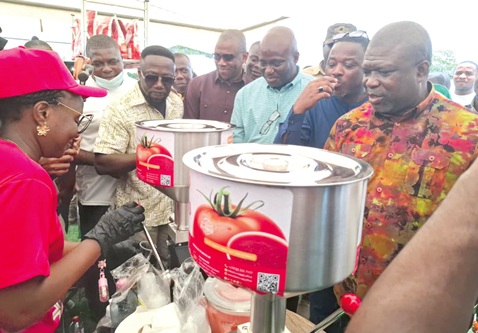
At the launch of the Ghana Tomatoes Self-Sufficiency Initiative (GHATSI) at Anloga in the Volta Region, the Minister of Food and Agriculture, Eric Opoku, said an inventory conducted when the government assumed office showed that most irrigation infrastructure across the country was operating below capacity.
He said some of the facilities, including those constructed during the era of Ghana’s first President, Dr Kwame Nkrumah, were performing at as little as five per cent of their capacity.
He said President John Dramani Mahama had provided financial backing for the rehabilitation of all existing facilities nationwide, and assured the chiefs and people of the Volta Region that theirs would be completed by December 2027.
Mr Opoku affirmed that the mobile system, with a 10-horsepower diesel engine, aluminium pipes and 44 sprinklers, could irrigate five acres at a time.
facility, he said, was heavily subsidised, with government paying 60 per cent of the cost, while farmers paid 40 per cent, amounting to GH¢23,800.
Farmers who could not pay at once, he said, could enter a two-year hire purchase agreement.
Support services
On the dredging of lagoons and rivers for irrigation, Mr Opoku said the ministry would donate two brand new excavators to the Volta Regional Coordinating Council to facilitate the exercise.
He said an agreement had been reached with the Council for Scientific and Industrial Research (CSIR) to supply improved tomato seeds capable of yielding between 25 and 30 tonnes per acre by the end of November.
Mr Opoku said the ministry had also begun procurement of an additional 500 water pumps, after an initial distribution of 100 pumps earlier this year, and would allocate 200 cartons of organic fertiliser to dry season vegetable farmers in the region.
He said the free fertiliser distribution introduced as an emergency measure following the Akosombo spillage and the dry spell in the north would soon revert to a subsidy programme as farmers regained capacity.
The Volta Regional Minister, James Gunu, lauded the effort of the Minister of Food and Agriculture to bring into the region two out of the10 farmer service centres being constructed by the government nationwide this year.
He said the region had also benefited significantly from the Feed Ghana Programme, with 20,000 bags of fertiliser distributed across all 18 districts, in addition to a further 1,000 bags allocated to each district recently.
Mr Gunu said two new irrigation dams were being constructed at Vakpo and Kpando, while the 22 existing dams in the region would be rehabilitated following assurance from the minister.
Tomato initiative
The Volta Regional Minister said the tomato initiative was timely, particularly in the wake of reports that Burkina Faso would no longer export tomatoes to Ghana, describing the development as a challenge that also presented an opportunity to strengthen local production.
Mr Gunu added that Ghana had the land, water, climate and hardworking farmers to produce enough tomatoes, yet spent hundreds of millions of dollars importing tomatoes and tomato products.
He further said the Volta Region, with major tomato-producing areas such as Anloga, Keta, Akatsi North and Agotime Ziope, was well positioned to make a significant contribution to national self-sufficiency in tomato production.
He welcomed the initiative’s focus on irrigation, improved farm inputs, technical support, financing, insurance and guaranteed off-take, describing the measures as critical to boosting production and strengthening the tomato value chain.
