
Ghana can save money and protect more children by delivering malaria prevention and worm treatment together in one campaign, instead of running them separately, a new study has revealed.
In a presentation at the American Society of Tropical Medicine and Hygiene (ASTMH) annual meeting in Maryland, USA, Professor Muhammed Afolabi of the London School of Hygiene and Tropical Medicine (LSHTM) said the study was undertaken in the Pru East District in the Bono East Region, where the study enrolled 1,421 children aged five to 10 from public schools in a cluster-randomised trial.
He said children in the district currently received two different preventive treatments through two different campaigns.
Prof. Afolabi explained that the first was the seasonal malaria chemoprevention (SMC), where health workers gave malaria preventive drugs to children aged three to 59 months.
The second was mass drug administration for worms. Once a year, children aged five to 15 receive the drugs in school to treat intestinal worms and schistosomiasis, commonly known as bilharzia.
The World Health Organisation (WHO) now recommends expanding SMC to older children aged five to 10 because they also carry a high burden of malaria.
Prof. Afolabi said in Ghana, malaria, intestinal worms and bilharzia often affected the same children at the same time.
All three, he said, could cause anaemia, poor growth and poor school performance.
Safe
Prof. Afolabi said the study revealed that adding worm treatment to SMC was safe and did not make children sicker.
He said the researchers checked for side effects and monitored safety throughout.
They also measured haemoglobin, malaria, worm infection and the weight and height of participants during the trial.
The researcher said the trial did not give an extra boost to haemoglobin, but malaria fell sharply in both groups.
Anaemia is influenced by diet and other factors that were not fully controlled in the trial.
Good value for money
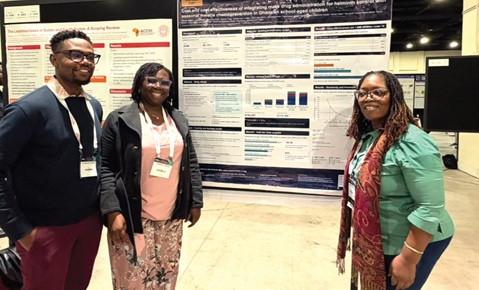
In a related development, making a poster presentation of an intervention in the same study, a senior research officer and health economist of the Ghana Health Service (GHS), Theresa Tawiah, said the researchers compared the current system in a separate delivery with a new approach of expanding SMC to children aged five to 10 and delivering it together with worm treatment in one integrated campaign.
She said over one season, delivering the two treatments separately would cost $194,497, while delivering them together would cost $179,398, thereby making $15,099 or 7.8 per cent savings.
Ms Tawiah said expanding SMC to older children and integrating it with worm treatment would cost $346 for each healthy year of life saved.
She said the study found a clear cut-off and that for expansion to remain cost-effective, malaria incidence in children aged five to 10 needed to be above 120 cases per 1,000 children per year.
Integration
For policy consideration, Ms Tawiah said the study concluded that integration would save money and that running one campaign instead of two avoided duplication.
Additionally, she stated that expansion added cost but also value and that protecting older children cost more in total but the health gain justified it at $346 per healthy year saved.
Furthermore, expansion should be prioritised in districts where malaria in five to 10-year-olds was high enough to make it cost-effective, she added.
Ms Tawiah said for districts such as Pru-East where malaria remained high in school-age children, combining malaria prevention with worm treatment was not just simpler for health workers and families but was also cheaper and good value for money.
