
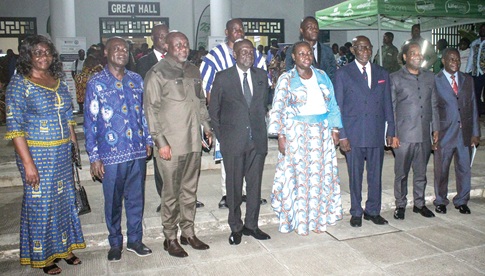
A Business consultant, Ishmael Yamson, has called for an institutional reset to address the structural weaknesses in the country’s governance system, warning that economic stabilisation alone will not deliver the desired transformation.
He said although the country had developed many development plans since independence, the challenge had been the failure to translate those aspirations into consistent implementation and measurable results.
“Our principal problem has not been the absence of ideas, it has been the difficulty of converting ideas into consistent, disciplined and sustained implementation.
We have often been very good at imagining the Ghana we want, but we have been less successful at building the institutions capable of delivering it,” he said.
Mr Yamson, who is also the Board Chairman of MTN Ghana, stated this at the 2026 University of Ghana Alumni Lecture in Accra, on the theme: “From Vision to Transformation: Can Ghana Really Reset to Inspire an Africa Reset?”
Political administration
Mr Yamson said the country’s development challenge required a deliberate effort to strengthen public institutions, improve accountability and ensure that national policies survived changes in political administration.
He stressed the need to distinguish the state from the political parties that temporarily assumed power, saying public institutions must serve the interests of the country rather than those of a governing party.
“The party is temporary, the government is temporary, but the state is permanent.
A political party must win the state in order to govern, but it must never own the state,” he said.
He called for a national development compact that would secure agreement across political parties on key priorities, including fiscal responsibility, industrialisation, agriculture, human capital development, infrastructure, energy security and export competitiveness.
Mr Yamson also proposed reforms to depoliticise the public service, strengthen the independence of constitutional and regulatory bodies, enforce campaign financing rules and professionalise the boards and management of state-owned enterprises.
Other measures, he said, should include an independent and integrated public procurement system, stronger accountability institutions, effective asset declaration and conflict-of-interest rules, as well as performance contracts for public officials.
Reset agenda
Mr Yamson commended the government and the Minister of Finance for the progress made in stabilising the economy, particularly in relation to macroeconomic conditions, debt management, foreign reserves and investor confidence.
He said the next stage should focus on institutional reforms to improve public administration, strengthen accountability, reform state-owned enterprises, ensure transparent procurement and create a predictable environment for businesses.
He explained that transformation required a shift towards productivity, industrialisation, value addition and the creation of quality jobs, as well as the development of Ghanaian businesses capable of competing in international markets.
Africa’s transformation
Mr Yamson urged African countries to prioritise industrialisation and value addition to be able to move beyond exporting cocoa beans to producing finished chocolate and processing minerals locally.
On the African Continental Free Trade Area (AfCFTA), he said the agreement offered an important opportunity to expand trade and strengthen economic integration, but its success would depend on the readiness of countries to address practical barriers to trade.
“Signing an agreement does not create a market,” he said, explaining that the continent needed competitive industries, efficient ports, reliable electricity, roads and railway networks, functional customs systems, digital infrastructure and predictable regulations to make the single market work.
He also called for African countries to mobilise domestic capital, including funds from pension schemes, insurance companies, sovereign wealth funds, banks, institutional investors and the diaspora, to finance the continent’s development.
Mr Yamson said Africa must reposition itself from being a recipient of aid to an investment partner, a supplier of commodities to an industrial partner, and a market for other economies to a market capable of driving its own growth.
