
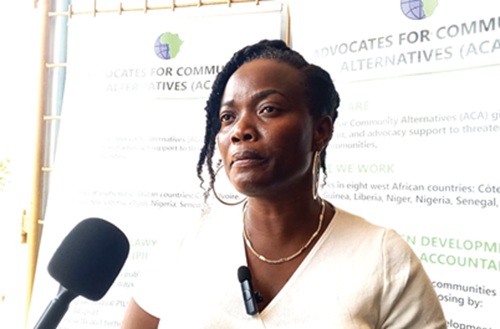
A two-year community-driven development initiative aimed at empowering 100 communities in the West Mamprusi Municipality of the North East Region through grassroots participation and civic engagement has been launched in Walewale.
Dubbed “Ting Labginsim”, the initiative seeks to strengthen community ownership of development by enabling residents to identify their own priorities and take collective action to address them.
It is a partnership among Advocates for Community Alternatives (ACA), Spark Microgrants Ghana, Water and Sanitation for Urban Populations (WSUP) and the West Mamprusi Municipal Assembly.
So far, 50 communities have been enrolled in the programme, with the remaining 50 expected to be enrolled in 2027.
Under the partnership, the ACA would provide a US$8,000 microgrant for each community project, amounting to US$800,000 for the 100 communities, while the municipal assembly would also contribute US$400 per community, amounting to a total assembly counterpart contribution of US$40,000 the beneficiary communities.
Community ownership
Launching the project last Wednesday, the Director for Community-Driven Development at the ACA, Nana Ama Nketia-Quaidoo, said the initiative built on the experience of the Facilitated Collective Action Process (FCAP) implementation in 107 communities in the Fanteakwa South, Nkoranza South and Abuakwa South municipalities in the southern part of the country over the past nine years.
She explained that FCAP had been translated into Mampruli as “Ting Labginsim” to deepen community understanding and ownership of the development process.
According to her, the 107 communities had collectively implemented 107 projects, including clinics, schools, laboratories, markets, boreholes, poultry farms, palm oil processing centres, milling stations, soap-making centres, teachers’ and nurses’ bungalows and community centres.

Participants in the event
Ms Nketia-Quaidoo said the same opportunity had now been extended to communities in West Mamprusi, with the partnership designed to encourage residents to contribute their time, ideas, labour and local resources to the development process.
She said the financial contributions were only one aspect of the partnership, stressing that the ultimate objective was to promote ownership of development projects by the communities.
Ms Nketia-Quaidoo said the West Mamprusi Municipal Assembly was selected because of its experience with participatory community planning and its demonstrated commitment to involving citizens in identifying and addressing development priorities.
She said the assembly would play a critical role in the implementation of the initiative by providing supervision, encouragement and technical guidance through its relevant departments.
She indicated that a steering committee had also been established to provide oversight of the partnership, adding that the committee, headed by the Municipal Chief Executive (MCE) and comprising representatives of relevant partners, would meet quarterly to review progress, challenges and innovations.
Ms Nketia-Quaidoo said the ultimate measure of success would not only be the completion of 100 projects but the ability of communities to continue meeting and identifying ways to address their development needs with locally available resources.
Community-driven
For her part, the Country Director of Spark Microgrants Ghana, Ann Squire, said the organisation believed that people who were closest to community problems were also well placed to identify solutions to them.
She added that instead of imposing solutions on communities, the initiative would facilitate a process through which residents would identify their priorities and take collective action through community meetings.
Ms Squire said the approach was intended to ensure that development interventions reflected the needs identified by the communities themselves.
Sanitation focus
The Country Manager of the WSUP, Frank Kettey, said the West Mamprusi Municipal Assembly was selected as a partner because of its proactive approach to sanitation.
He said the assembly had demonstrated leadership and commitment to addressing sanitation challenges, including efforts to combat open defecation and improve access to Water,
Sanitation and Hygiene (WASH) services in communities and schools.
He said the decision to partner the assembly was also informed by its willingness to take ownership of sanitation initiatives and work with communities to improve WASH services.
Assembly pledges support
The Municipal Chief Executive for West Mamprusi, Mohammed Rabiu Jabaah, welcomed the partnership and pledged its support for the successful implementation of the initiative.
He said the assembly would work with the partners and participating communities to ensure that the objectives of the initiative were achieved.
