
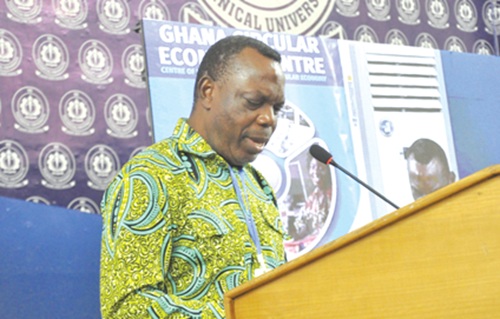
The Technical University (HTU) has announced plans to roll out a number of short certificate and professional development courses in circular economy-related area.
“Beyond the classroom, HTU is leveraging the Ghana Circular Economy Centre Project to strengthen its work in innovation, entrepreneurship, and technology development,” said the Vice Chancellor, Professor Ben Q. Honyenuga.
He said this at the opening of the maiden Ghana Circular Economy Conference in Ho on Wednesday (October 7).
The two-day conference was on the theme: Circular Economy in Action – Advancing Sustainable Innovation, Industrial Growth, Investment and Job Creation in Ghana.
The conference, which attracted a massive public attendance, including entrepreneurs and students, was organised by the Government of Ghana, United Nations Industrial Development Organisation (UNIDO), and Global Affairs Canada.
It focused on Circular economy policy and industrial transformation, Sustainable innovation an enterprise development, and Circular economy investment and financing.
The topics also included Job creation and Ghana 24-hour economy; Plastics, textiles, agriculture and agro-processing value chains, Circular economy products, prototypes and solutions; and Policy dialogue and cross-sector collaboration.
Professor Honyenuga said HTU, through its incubation programmes and innovation spaces, supported the ideation, piloting, testing, and validation of circular economy innovations and business models.
“In this way, the university is creating a connected pathway from education and skills development to research, enterprise creation and the practical application of circular solutions,” he said.
The Vice Chancellor affirmed HTU was committed to translating its institutional vison into action by developing high competent human capital through career-focused education, skills training, research, and innovation, in partnership with industry, government, development partners and other stakeholders.
For that matter, he maintained, HTU aligned strongly with the government’s ambition to position the country as a regional and international leader in the circular economy.
“We recognise that achieving this ambition will require a skilled workforce of technicians, artisans, and tradesmen equipped with the knowledge and practical expertise needed to advance the transition to a circular economy,” he said.
Accordingly, Professor Honyenuga said the university was committed to embedding circular economy principles and practices into its teaching, research, and community engagement programmes.
In a speech read on her behalf, the Minister of Environment, Science and Technology, Dr Zanetor Agyeman-Rawlings said the Ghana Circular Economy Centre supported the country’s shift from a linear economy, where resources were extracted, used and discarded, to one that kept materials and value in productive use.
She said through the Centre of Excellence at HTU, technical assistance and capacity building, access to finance, and networking and knowledge exchange, it brought together policy, research, enterprise, finance, skills and markets.
The Regional Minister, James Gunu, in speech read on his behalf, said although the country faced challenges such as indiscriminate waste disposal and environmental degradation, the Volta Region took pride in maintaining relatively clean and green communities.
He said the region was also on record for protecting its water bodies from the devastating effects of illegal mining.
“We must, therefore, preserve these gains while doing more to address waste management and other emerging environmental challenges,” Mr Gunu added.
The Ghana Circular Economy Centre was launched at the HTU two years ago to support innovators seeking to develop and scale circular economy solutions.
